

- The root problem Most shared gifts don't require two kids — one child dominates, the other resents it, and the gift becomes a new source of conflict.
- What actually works Gifts that require two players by design — cooperative games, matched gear, partner experiments, and creative kits with double supplies — remove the dominance dynamic entirely.
- The anti-rivalry hero A custom coloring book starring both siblings together celebrates their bond rather than creating competition, and keeps kids coloring side-by-side for weeks.
- Order timing matters Memory Doodle custom coloring books take 5–7 business days to ship — plan ahead and upload close-up photos for the cleanest line-art results.

Why Most "Shared Gifts" End Up Causing More Fights Than Fun
The problem with most shared gifts isn't the gift itself — it's that they don't actually require two kids. One child claims ownership within hours, the other feels left out, and the gift designed to bring them together becomes the newest source of tension in your house.
You probably know exactly how this plays out. You spend $80 on a LEGO set, wrap it beautifully, label it "For Both of You," and by lunchtime, the older kid has claimed the instruction booklet and the younger one is crying because they were handed a pile of random bricks.
That's not a parenting failure. That's just how kids work.
Child development researchers at the ZERO TO THREE organization note that sibling conflict over shared objects peaks between ages 3 and 8 — precisely because children in that range are still developing the impulse control and perspective-taking skills that cooperative play demands. A shared gift without built-in collaboration mechanics is just a competition waiting to happen.
So what actually works? Gifts that either require two players by design, give each child an equal and distinct role, or create enough materials for simultaneous, side-by-side engagement. The 15 options below are organized by play style — cooperative board games, active play gear, creative kits, shared story books, STEM toys, and experience gifts — so you can match the right gift to how your particular kids actually play.
One category on this list stands out as the anti-rivalry gift: custom coloring books that star both siblings as the main characters. More on that in a moment.
1. Cooperative Board Games That Can't Be Won Alone
Cooperative board games where players team up against the game itself are among the best shared gifts for siblings because winning requires both kids. There's no "I beat you" moment — only "we did it together."
This is the key shift. Traditional competitive games create a winner and a loser, which almost always maps onto the older kid and the younger kid. Cooperative games flip that entirely.
Outfoxed! (ages 5+) is a fantastic starting point. Players work together to catch a thieving fox before it escapes. Each player contributes clues, and the game is genuinely tense without anyone being the villain. It plays in about 20 minutes, which is a real consideration when you've got kids with different attention spans.
Hoot Owl Hoot! (ages 4+) is gentler — players cooperatively fly owls back to the nest before sunrise. It's one of the few games that works beautifully with a 3-year-old and a 7-year-old at the same table.
For older siblings (8+), Forbidden Island raises the stakes considerably. Players take on different roles — Navigator, Engineer, Messenger — so each child has a unique power. That role assignment is important. It's hard to dominate your sibling when they're the only one who can do their specific job.
Look for games that list specific role cards on the box. That's your signal that the game was designed for genuine collaboration, not just parallel play.
2. Badminton Sets, Catch Games, and Active Gear Built for Two
Physical play equipment that requires a partner — like a badminton set, a two-person catch game, or a toss-and-catch ball set — eliminates the dominance problem because neither child can play without the other. The game literally doesn't work alone.
There's something about getting outside and moving that also just dissolves tension faster than anything happening indoors. Ten minutes of backyard badminton tends to reset whatever was happening at the breakfast table.
A few things worth considering for age gaps:
- Velcro toss sets (ages 4+): Soft, safe, and genuinely fun for wide age gaps. No one gets hurt, and a 4-year-old can play with a 9-year-old without frustration.
- Badminton sets (ages 6+): Great for backyards. Look for sets with two rackets so there's no arguing about who gets "the good one."
- Stomp rockets: Technically involves taking turns, but the combination of launching and chasing makes it feel more cooperative than competitive.
The "matched sets" principle matters here. Two identical items are almost always better than one shared item. Two rackets, two gloves, two launchers. It costs a little more, but you're buying peace.
When gifting active gear to siblings with a 3+ year age gap, buy equipment calibrated to the younger child's ability, not the older one's. A badminton set sized for a 5-year-old lets both kids play on equal footing — the older child learns to adjust their game, which is actually a more valuable skill than winning against a smaller opponent.
3. Art Sets and Creative Kits With Enough Supplies for Two
Creative kits work as sibling gifts when they contain enough materials for both children to create simultaneously — not take turns. Look for kits that include double the supplies, or buy two of the same kit intentionally.
Resource guarding is one of the most common sources of creative-kit conflict. One child has the purple marker. The other one needs it. You know the rest.
A few kits that avoid this:
- Friendship bracelet sets with large thread assortments — there's genuinely enough for two kids to make bracelets for weeks
- Air-dry clay kits with multiple colors packaged individually (each child gets their own colors)
- Scratch art kits that include 20+ sheets — both kids can scratch away without anyone guarding supplies
Side-by-side creative play, what child development researchers call parallel play, is actually a developmental stepping stone toward full cooperative play. Kids as young as 2 engage in it. For siblings with a meaningful age gap, a creative kit that lets them each make their own thing — while sitting together and talking — can be more bonding than a game that requires constant interaction.
The best creative gifts end up covering the kitchen table. That's a good sign.
4. Two-Player Card Games That Fit in a Pocket
Two-player card games are underrated sibling gifts because they're portable, quick to learn, and designed specifically for two — no waiting for others, no one sitting out.
Taco Cat Goat Cheese Pizza plays 2–8, but honestly some of the most chaotic fun is with just two kids. It takes about 3 minutes to explain to a 5-year-old and keeps them genuinely entertained for 20 minutes at a stretch.
Slapzi is another gem — picture matching under pressure, great for mixed ages because speed and recognition matter more than reading ability.
For older siblings, Lost Cities is a two-player-only card game that's been beloved for 25 years. It's genuinely strategic and takes about 30 minutes. Tweens will actually want to play it again.
These make excellent stocking stuffers, too. Under $20, small enough to travel, and they require exactly two people.
5. STEM Kits Designed for Partner Experiments
Science and engineering kits that involve hypothesis-testing and building together are particularly good for siblings with a 2–4 year age gap, because the older child naturally takes on an explaining role while the younger one contributes hands-on steps.
That dynamic — teaching and doing — is genuinely valuable. The older child cements their understanding by explaining it. The younger one feels included and capable. Both feel proud of whatever they built or grew or launched.
A few solid options:
- Snap Circuits Jr. (ages 8+ with a younger sibling as assistant): Building working electronic circuits together. The "it actually lights up" moment is genuinely exciting for both kids.
- Klutz Lego Chain Reactions: Designing and building chain reaction machines. Open-ended enough that both kids can contribute ideas.
- Thames & Kosmos Kids First Science Laboratory (ages 4+): 25 experiments using household materials. Simple enough that a 4-year-old can participate meaningfully.
One note: the kits that come with a printed experiment guide work better than ones that require an app. Screens introduce a new argument about who holds the tablet.
6. Shared Puzzle Sets That Build Toward Something
Puzzles are genuinely cooperative by design — no single piece "belongs" to either child, and the finished image only appears when both kids contribute. For siblings who tend to compete, puzzles reorient the energy toward a shared goal.
For younger siblings (ages 4–7), look for floor puzzles with 24–48 large pieces. They're satisfying to finish in one sitting.
For older kids, the Wasgij puzzle series adds a clever twist: the image on the box is NOT what you're building. You build the "reaction" to the scene on the box. It adds conversation and creative guessing to the experience — both kids are theorizing out loud while they sort pieces.
Personalized photo puzzles exist too. Some families order custom puzzles made from a family photo. The recognition moment — "that's us!" — keeps kids engaged longer than a generic landscape.
7. Matching Outdoor Gear That Makes Them a Team
Matching outdoor gear — identical helmets, color-coordinated scooters, matching water bottles — signals to both children that they're part of the same team, not in competition. It's a simple psychological shift that works surprisingly well.
This is less about the gear itself and more about the framing. Two matching scooters presented together as "your team gear" lands differently than one scooter with a note that says "share this."
It's not even close, the response to "yours AND yours" versus "yours TO SHARE."
Matching rain gear, matching backpacks for hikes, even matching headlamps for camping — these create a sibling identity that's genuinely bonding. They're on the same adventure team. That matters more than the product itself.
8. Flip Books, Puzzle Adventures, and Two-Reader Story Books
Interactive books designed for two readers — choose-your-own-adventure formats, flip-narrative books, or two-sided puzzle stories — keep both kids engaged because each reader controls part of the narrative.
The You Choose series works beautifully for siblings because one child can "navigate" while the other "decides." It's collaborative storytelling with a built-in structure that prevents one kid from steamrolling the other.
The Escape Room in a Book series is fantastic for older siblings (8+). The puzzles genuinely require two brains — not just one person reading aloud while the other watches.
But the most powerful version of this category is personalized. When kids see themselves in the story, the engagement level changes entirely. There's actual research behind this — recognition accelerates engagement and learning, because a child who sees their own face in a book pays a different quality of attention than one reading about fictional characters.
Which brings us to the gift on this list that most parents overlook.
If you're shopping for two siblings who need something that celebrates their bond — not their competition — a custom coloring book starring both of them is genuinely worth considering.
Memory Doodle Custom Coloring Book
"Washable markers or colored pencils"
Learn More →9. A Custom Coloring Book Starring Both Siblings

A personalized coloring book made from photos of both siblings together is one of the most effective anti-rivalry gifts because it celebrates their relationship as the story. Both children are the heroes. There's nothing to compete for — they're already on the same page, literally.
Here's how it works with Memory Doodle: you upload photos of your kids together — at the beach, during the holidays, at grandma's house, making a mess in the kitchen — and those photos get transformed into beautiful line-art coloring pages. Your kids color their own memories. Side by side. No fighting over whose character is cooler, because they're both in every picture.
One mom described watching her two daughters open their Memory Doodle book together: "The older one immediately found a page from their camping trip last summer and just lit up. The little one started coloring before we even finished explaining what it was."
That recognition moment — kids spotting themselves in the drawings — is what keeps them coloring for weeks instead of days. It's not a generic princess or dinosaur they're coloring. It's their dog. Their backyard. Their faces.
The paper is heavy enough that markers don't bleed through, which matters when a 4-year-old is involved. And because both children are equally represented on every page, there's no arguing about whose book it is. It's both of theirs.
One honest note: Memory Doodle takes 5–7 business days to ship, so it's not a last-minute gift. Order it at least a week before you need it. Also, close-up photos of faces convert more cleanly than distant group shots — so pick your best ones.
For more ideas on screen-free activities that genuinely hold kids' attention, this roundup of screen-free activities for young kids has some great companion ideas to pair with a coloring book gift.
Here's how the most popular sibling gift approaches stack up:
| Feature | Custom Coloring Book | Cooperative Board Game | Free Printable Pages |
|---|---|---|---|
| Requires two kids to use | Side-by-side coloring — no partner required but invites it naturally | Yes — players must work together to win | No — one child can use alone |
| Personalized to your family | Yes — stars your actual children and their memories | No — generic characters and themes | No — generic clip art or characters |
| Cost | Paid — premium custom order | Paid — typically $20–$35 | Free — printable from home |
| Replay value | High — kids return to color more pages for weeks | High — can replay with different strategies | Low — kids lose interest quickly without personal connection |
| Screen-free activity | Yes — completely screen-free | Yes — completely screen-free | Requires a screen to print |
| Becomes a keepsake | Yes — finished pages become lasting family art | No — not a keepsake format | No — low-quality paper, not meant to save |
| Works for wide age gaps | Yes — any age can color at their own level | Depends — cooperative games have age minimums | Yes — any age can color |
10. Coding Robots and Engineering Challenges for Partner Play
Coding and robotics kits designed for two users — where one child programs while the other physically sets up the course or obstacle — are among the best gifts for siblings who are both curious and competitive, because they channel that energy into problem-solving.
Botley 2.0 (ages 5+) is genuinely screen-free, which is a real plus. One child codes the sequence using physical buttons; the other sets up the obstacle course. They swap roles naturally.
Kano Computer Kit (ages 7+) is better suited for older siblings who want to understand how computers work. Building and programming it together over a weekend afternoon is a legitimate shared experience.
For mixed-age pairs where one sibling is elementary and one is tween, the Gravity Maze marble run logic game threads the needle nicely — it's puzzle-based rather than screen-based, and an older sibling can genuinely help a younger one without it feeling patronizing.
11. Subscription Boxes Delivered to Both Names
Monthly subscription boxes addressed to both siblings — especially hands-on science or art kits — work as ongoing shared gifts because each delivery is a new shared activity, not a one-time object either child can claim.
The key is to choose a box that includes enough materials for two. Kiwi Co's Tinker Crate (ages 9+) is designed for solo use but includes enough material that two kids can easily collaborate. Their Koala Crate (ages 3–4) is specifically designed for doing together with a caregiver — a sibling works just as well.
One genuine alternative worth naming: Little Passports makes a lovely subscription that includes a shared story and activities. It's more about reading and exploring together than building, so it suits siblings who enjoy story-driven play. It's not as hands-on as Kiwi Co, but the narrative element means both kids are invested in the same "character" each month.
12. Building Sets With Two Simultaneous Projects
Large LEGO sets that include two separate instruction booklets — or two smaller sets bundled together — let siblings build simultaneously without competing for pieces, because each child has their own build.
This is a popular misconception worth addressing directly: a big LEGO set is not automatically a good sibling gift. If it has one instruction booklet and one final model, one child builds while the other watches (or "helps" by knocking things over). That's not sharing — it's spectating.
Look specifically for LEGO sets that include two builds in one box. The LEGO Creator 3-in-1 series sometimes includes components that can be split into parallel projects. Even better: buy two of the same smaller set. Each child builds their own identical model. Then, if they want, they can combine them into something bigger together.
Parallel construction — each kid building their own thing at the same table — produces less conflict and more conversation than one person holding the manual and the other handing pieces.
13. Music-Making Tools Designed for Duets
Instrument pairs — hand drums, matching ukuleles, or call-and-response percussion sets — are underused sibling gifts because music-making together is inherently social and doesn't produce a winner.
You don't need to be musical to appreciate this. A hand drum and a shaker set packaged together (roughly $30–$40 total) gives both kids something to play, and the resulting noise is — well, it's loud, but it's their noise. Together.
For older siblings, matched ukuleles (two starter ukuleles, one tuner) is a gift that could genuinely turn into a years-long hobby. Learning an instrument together, at the same pace, removes the competitiveness of "who's better" and replaces it with shared progress.
Chatbooks makes a gorgeous photo book you can flip through together — it's beautiful for shared memories and worth mentioning — but it's designed for looking, not doing. Music-making has the advantage of being active, loud, and impossible to do alone.
14. Experience Gifts That Require Two Participants
Experience gifts — cooking classes, escape rooms, pottery studios, or adventure park day passes — are among the most lasting sibling gifts because the memory belongs to both children equally, and neither child can "claim" an experience the way they can claim an object.
The gift of a shared experience sidesteps almost every rivalry dynamic. There's no ownership. There's no "mine." There's just the afternoon they spent doing that thing together.
Some strong options depending on ages:
- Kids' cooking class for two (ages 6+): Most cooking schools offer sibling sessions. They make the same dish. They eat it together. It's genuinely sweet.
- Escape room (ages 10+, and many companies offer kid-friendly versions): Built entirely on cooperation. You literally cannot succeed without working together.
- Indoor climbing gym day pass: Physical, active, and one child belays while the other climbs. It's a trust exercise disguised as a birthday present.
Pairing an experience gift with something tangible — like a custom coloring book they can fill in with memories from their day — gives both kids something to hold onto after the adventure ends.
15. Custom Experience Journals Built Around Their Shared Story
A custom activity journal or shared memory book that documents both siblings' experiences together is the gift that keeps growing — kids add to it over months, and the finished product becomes a keepsake of their childhood relationship.
This is the gift that benefits most from personalization. A generic journal stays blank. A journal that already has their names on it, their photos in it, and their memories sketched out in coloring-book style? That one gets picked up again and again.
For families who want to go deeper into why this kind of personalized, screen-free activity works so well for siblings, this guide on creating shared sibling harmony with custom art packs is worth reading before you order.
And if you're still thinking through the rivalry dynamics at play — why some gifts cause conflict and others genuinely don't — this guide on stopping sibling jealousy and sparking shared play goes deep on the psychology in a way that'll change how you approach all your gift-buying.
One last thing that doesn't fit anywhere else on this list, but is genuinely worth knowing: kids who spend time in creative, screen-free play together before age 8 show stronger conflict resolution skills as teenagers, according to research from the American Psychological Association. The gifts you choose now aren't just about a fun afternoon. They're practice for the relationship they'll have for the rest of their lives.
That's worth taking seriously.
- Both siblings star in every page — no competition for whose character is better
- Heavy artist-grade paper holds up to markers, crayons, and enthusiastic 4-year-olds
- Lay-flat binding means little hands can color without fighting the spine
- Becomes a genuine keepsake — parents regularly report kids holding onto finished books for years
- Preview every page before ordering so there are no surprises
- Takes 5–7 business days to ship — not a last-minute gift option
- Close-up face photos convert best; distant group shots or low-light images may not produce clean line art
Want a gift that brings your kids together instead of causing a fight?
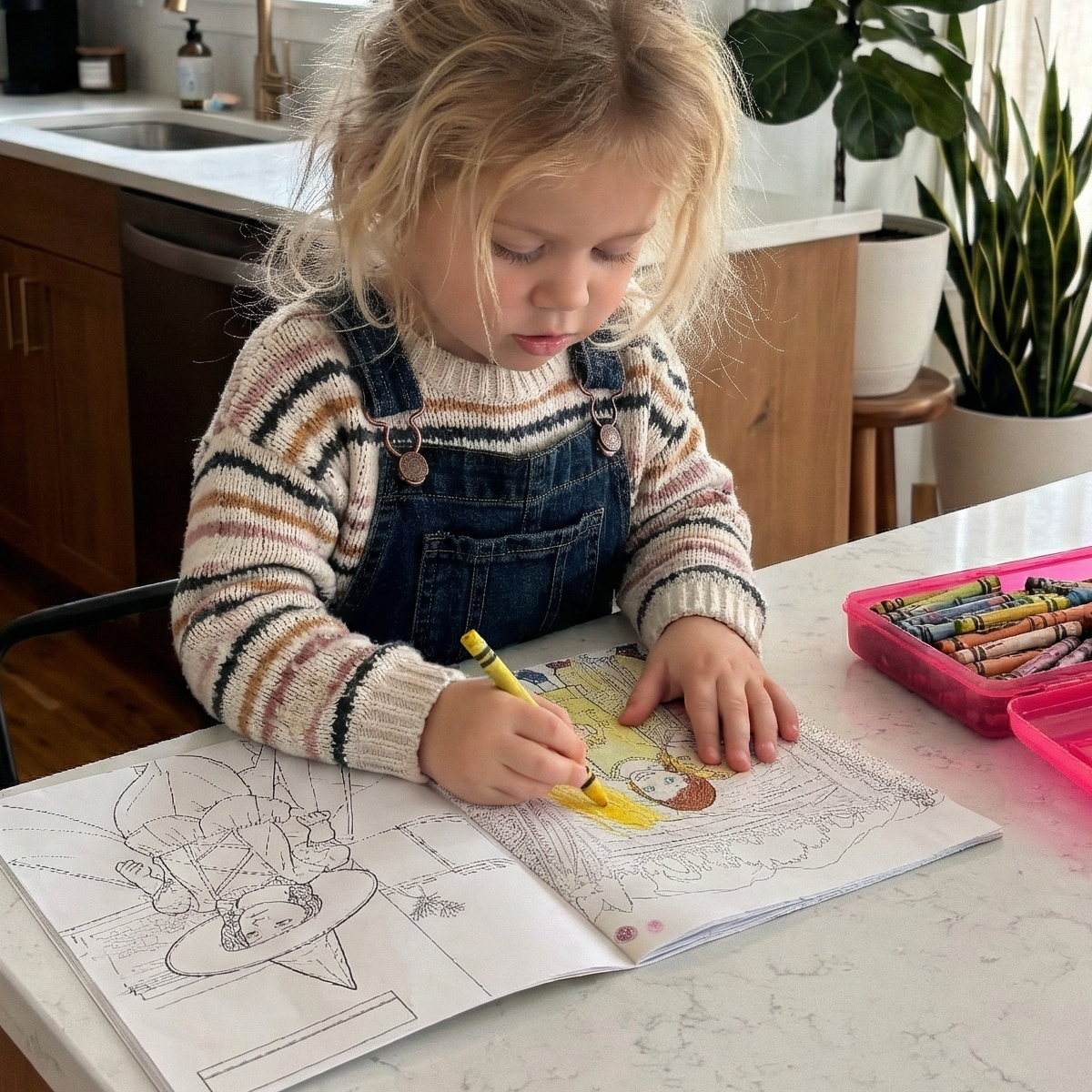
Memory Doodle is a premium storytelling service that transforms your favorite family snapshots into beautiful, custom-bound coloring books....
- Instant Peace: Enjoy 30–60 minutes of quiet, screen-free focus while your child explores their creativity.
- The "Look, It’s Me!" Moment: Boost your child’s confidence by making them the hero of their very own book.
- Meaningful Gifting: Easily share the joy with your inner circle using our simple digital gift codes.
Frequently Asked Questions
What age gap is too big for a shared gift?
How do you stop the older sibling from taking over a shared gift?
Are personalized gifts worth the extra cost for siblings?
How many shared gifts should I give versus individual gifts?