

- Free comes first Activities 1–3 use things you already have at home — flour, tape, baking soda — and genuinely hold a 4-year-old's attention for 20–45 minutes.
- More activities is not always better Activity 4 challenges the common mistake of overscheduling — unstructured free play builds the self-regulation skills that let kids entertain themselves.
- Personal recognition is the secret to sustained attention Activities featuring a child's own face, family, or memories — like a personalized coloring book — keep 4-year-olds returning to the same activity for weeks, not minutes.
- Boredom is the last activity on the list for a reason Teaching a child to sit with 15 unstructured minutes is harder than any craft project, but it's the one habit that eventually gives you an hour of peace.

Four-year-olds spend an average of 3 hours a day in front of screens — more than they spend playing outside. Here are 15 screen-free activities that actually hold their attention, ranked from easiest to set up to the ones that keep them busy the longest.
1. Play Dough from Your Pantry
Mix 1 cup flour, ½ cup salt, 2 teaspoons cream of tartar, 1 cup water, and 1 tablespoon oil in a saucepan over medium heat. Stir for 3–5 minutes until it pulls away from the sides. Let it cool, then add food coloring. This batch lasts up to 3 months in a sealed container.
This is the activity I come back to more than any other. It takes about 10 minutes to make, and a 4-year-old will sit with it for 45 minutes easy.
The trick most people skip: add a few drops of essential oil — lavender or peppermint — to the dough while it's still warm. The scent makes the whole sensory experience calmer. My daughter once asked me to make "the purple smelly one" every single week for two months straight.
Set out some cookie cutters, a rolling pin, and a plastic knife and you've got a full afternoon sorted. Four-year-olds are right in the developmental window for this kind of open-ended, tactile play — their fine motor skills are developing fast, and working with dough builds hand strength for writing later.
2. Tape Roads on the Floor
Use painter's tape to create roads, parking lots, and intersections directly on your floor or a large piece of cardboard. Toy cars, animals, or even wooden blocks become props in an instant city. Setup takes 5 minutes and the play can last all morning.
Painter's tape peels off cleanly from hardwood, tile, and most carpets. Use it to create a basic road map, then let your child add to it. They'll start directing the story almost immediately.
This is one of those activities that grows as they play. What starts as a road becomes an airport. The airport gets a zoo next to it. Suddenly it's a whole world, and you didn't buy a single new toy.
3. Baking Soda and Vinegar "Volcano" in a Tray
Pour a layer of baking soda into a baking tray, add a few drops of food coloring, and give your child a small cup of white vinegar with a dropper or spoon. The fizzing reaction is immediate and endlessly repeatable. This costs less than $2 and keeps most 4-year-olds busy for 20–30 minutes.
You've probably seen the standard volcano version. This tray method is better. Spread the baking soda flat so they can drop vinegar in different spots and watch multiple reactions at once. Add a few plastic dinosaurs half-buried in the soda for a "prehistoric explosion" theme and the whole thing becomes a story.
The fizzing eventually slows, but you can just add more baking soda and keep going. Rachel, a mom of three in our community, said her son asked to do this "science experiment" every afternoon for a week before he finally moved on.
Most 4-year-olds hit a focus wall after 20–25 minutes of any single activity — not because they're bored, but because their prefrontal cortex genuinely needs a reset. Instead of switching to a new activity immediately, try a 5-minute physical break (jumping, spinning, running a hallway lap) before offering something new. That brief movement resets attention better than a snack or screen ever will, and you'll get a full second round of focused play.
4. Don't Freeze Your Kid's Boredom Away
Structured, adult-led activity back-to-back is actually less effective for 4-year-olds than short bursts of independent, open-ended play. Child development research from the American Academy of Pediatrics shows that unstructured free play — not organized activities — builds the executive function skills kids need most at this age.
Here's what a lot of parents get wrong: they think more activities equals more engagement. So they schedule one thing after another, and then wonder why their child is still melting down by 3pm.
The truth is, the American Academy of Pediatrics is clear that 4-year-olds need unstructured time to direct their own play. When we fill every minute, we rob them of the chance to practice self-regulation — the very skill that would let them play independently for 30 minutes while you drink a hot coffee.
This is the debunk: the problem usually isn't that your child needs more activities. It's that they haven't had enough practice entertaining themselves. A couple of open-ended activities each day, then stepping back, does more than a full schedule of craft projects ever could.
If you want a deeper look at creating that quiet, independent play window, The Art of "Quiet Time" walks through exactly how to build that habit — even if your child has never played independently before.
5. Ice Excavation

Freeze small plastic toys, coins, or buttons in a block of water overnight. Give your child a bowl of warm water, a dropper, and a plastic fork. They chip, drip, and dig until the toys are free. Most 4-year-olds will work at this for 30–40 minutes without stopping.
Freeze in a bread pan for a rectangular block, or use a mixing bowl for a rounded one. Silicone molds in fun shapes make it even more exciting.
This one works so well because it has a built-in goal — rescue the toys — and the time pressure of the ice slowly melting. The focus is remarkable. I've watched kids who "can't sit still" stay completely locked in on this for 45 minutes.
Keep a towel nearby. It gets splashy, which is half the fun.
If you're looking for more ideas specifically for rainy days when you're stuck inside, the 10 Creative Ways to Reduce Toddler Screen Time When You're Stuck Indoors guide has some great additions to this list.
6. Obstacle Course with Couch Cushions
Stack couch cushions into walls, line up pillows as stepping stones, drape a blanket over two chairs for a tunnel, and use a hula hoop or piece of tape as the finish line. A 10-minute setup gives you a physical activity that burns real energy for 20–40 minutes.
Let your child help you build it. The building is often more exciting than the actual course. Once it's up, time them with your phone and let them try to beat their record.
Four-year-olds love a challenge they can measure. "Can you do it in under 30 seconds?" is all the motivation most of them need.
7. Water Painting on Concrete
Give your child a cup of water and a paintbrush — the bigger the better — and let them "paint" the driveway, sidewalk, or a fence. The water dries and disappears, creating an endlessly repeatable blank canvas. Zero mess, zero cleanup, completely free.
This one sounds almost too simple. It isn't.
A 4-year-old with a big brush and a cup of water on a sunny day will paint happily for 20 minutes. They're not just making pictures — they're watching water evaporate in real time and noticing patterns in how it dries. There's genuine science happening in there, even if neither of you realizes it.
8. Sorting Games with Kitchen Items
Set out a muffin tin and a pile of mixed items — dried pasta shapes, dried beans, coins, buttons, or small toys — and ask your child to sort by color, shape, or size. For 4-year-olds, this builds early math concepts like classification and counting without any worksheets required.
The key is variety. Mix pasta shapes with buttons and small pompoms. Give them tweezers or tongs for extra fine-motor challenge. Older 4-year-olds can sort by two rules at once ("all the red things that are also round").
Muffin tins are perfect for this. Ice cube trays work too. Both give little hands a satisfying, defined space for each category.
9. Nature Walk Scavenger Hunt
Write or draw 5–8 items on a piece of paper — a smooth rock, something yellow, a feather, a curly leaf, something bumpy — and let your child check them off as they find them. This turns a regular walk into a 45-minute adventure with no additional cost.
Draw pictures instead of writing words so they can read the list themselves. That independence — holding the list, finding the item, making the check — is incredibly motivating for this age.
Go to the same spot every week and they'll start to notice what changes. A 4-year-old who goes on weekly nature hunts starts to understand seasons in a way that no book can teach.
10. Mess-Free Painting in a Bag
Squeeze blobs of washable paint into a ziplock bag, seal it tightly with extra tape along the top, and tape it flat to a window or table. Your child draws designs by pressing and smearing the paint through the bag — no brushes, no mess, and it peels right off when they're done.
Add two colors that mix well — yellow and blue, red and yellow — and they'll discover color mixing on their own. That moment when a 4-year-old realizes their fingers just made green? Pure magic.
This activity is especially good for younger siblings who would otherwise get into the paint. Everyone gets their own bag.
11. Story Stones

Collect 10–15 smooth rocks from outside and draw simple pictures on each one with a permanent marker — a sun, a house, a dog, a crown, a monster. Put them in a drawstring bag and let your child pull them out one at a time to build a story, in whatever order they come.
Making the stones together is the first activity. Using them is the second. Together that's a full morning.
Four-year-olds are in a prime window for narrative play — they love making up stories, adding characters, and building dramatic tension (usually involving a monster). Story stones give that imagination a structure without constraining it.
12. Coloring with a Personalized Book
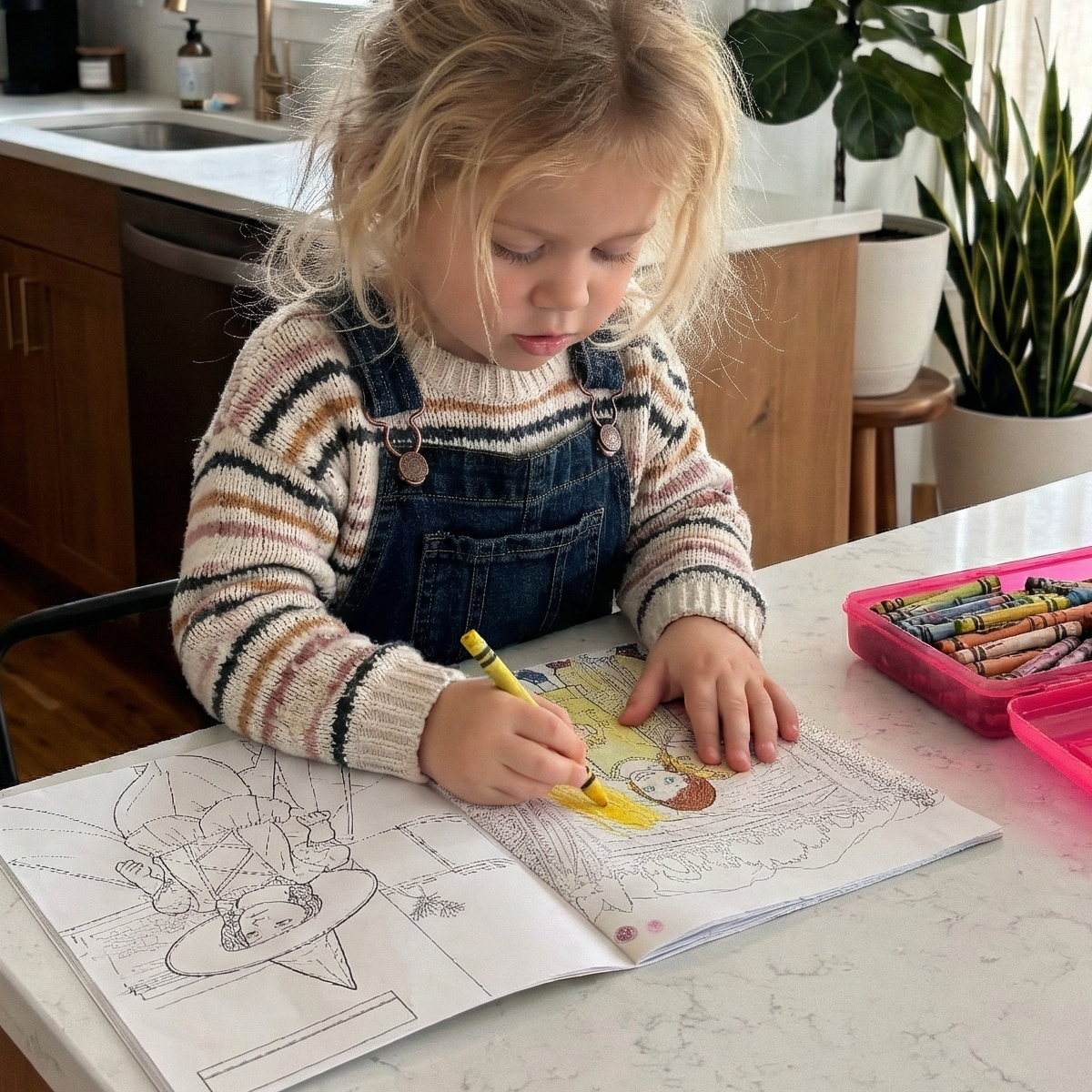
Personalized coloring books made from your own family photos hold a 4-year-old's attention significantly longer than generic coloring books — because the child recognizes the faces, the dog, the backyard. That recognition creates a sense of ownership and keeps them returning to the same book for weeks.
Generic coloring books are fine for a rainy afternoon. But they don't hold attention for a month. The characters are strangers. There's no personal story to tell.
That's where a personalized coloring book made from your own family photos does something genuinely different. Kids see themselves, their siblings, their grandparents — and suddenly coloring becomes storytelling. They're not filling in a cartoon; they're recreating a memory.
If you want a gift that gets used for weeks instead of minutes, here's what to look for: thick paper that won't bleed through with crayons or markers, pages that lay flat so little hands can color all the way to the edges, and photo quality that translates clearly into clean line art.
The best detail? Many 4-year-olds will color the same page multiple times — trying different color combinations, adding their own details, telling you what's happening in the picture. That's not just coloring. That's literacy, memory, and fine motor practice all at once.
For grandmothers looking for something that truly closes the distance, a Memory Doodle custom coloring book made from photos of the two of them together is one of those gifts that outlasts every toy. The grandchild colors the pages; the grandmother gets photos back of the finished artwork. That loop of connection is real. You can read more about it in 12 Heartwarming Long Distance Grandparent Gifts That Bridge the Miles Forever.
One honest note: the book takes 5–7 business days to ship, so it's not a same-day fix. And close-up face photos convert to line art much more cleanly than dark, distant, or blurry shots — so choose photos where faces are visible and well-lit.
Here's how the main coloring options for 4-year-olds actually compare:
| Feature | Memory Doodle | Generic Coloring Book | Free Printables |
|---|---|---|---|
| Holds attention after day 3 | Yes — kids return to familiar faces and memories | Rarely — characters are strangers with no personal story | No — novelty fades after one session |
| Cost | Paid — check memorydoodle.com for current pricing | ~$5–$12 per book | Free — just needs a printer |
| Keepsake value | High — parents and grandparents save finished pages for years | Low — usually recycled after use | None — single-use printout |
| Paper quality | Heavy artist-grade, no bleed-through | Thin — markers bleed through easily | Standard printer paper — minimal texture |
| How quickly you can start | 5–7 business days to ship after ordering | Available same day at any store | Immediate — print at home |
| Personal connection | Every page features your child's own family and memories | No personal connection — generic characters | No personal connection unless you create custom artwork yourself |
13. DIY Puppet Show
Draw faces on the fingers of an old glove, or tape paper faces onto wooden spoon handles. Set a blanket over two chairs as the "stage curtain." This creates a self-directed dramatic play setup most 4-year-olds will use independently for 20–30 minutes once it's ready.
The setup is the activity. Let your child help you make the puppets — even just scribbling faces on paper bags — and they're already invested before the first performance.
Puppet play at this age isn't just cute. It's one of the main ways 4-year-olds process emotions and practice social problem-solving. The puppet can be angry. The puppet can be scared. Things get worked out on stage that might be hard to talk about directly.
14. Memory Doodle Coloring Book as a Shared Activity
Sitting down to color together — a parent and child, or grandparent and grandchild — is one of the most effective screen-free bonding activities for 4-year-olds because it's side-by-side rather than face-to-face, which is actually less pressure for little ones and leads to more natural conversation.
Child development researchers call this "parallel play with a shared focus." When adults and children work on the same task side by side — without one person directing the other — conversation flows more naturally and kids open up more freely.
A personalized coloring book is perfect for this. You each pick a page, you sit together, and the conversation starts itself. "Who's that?" "What were we doing that day?" "Remember this trip?"
That's not a screen. That's a memory being made in the middle of one.
If siblings are in the picture too, From Chaos to Quiet: Create Shared Sibling Harmony with Custom Art Packs shows how personalized coloring can actually reduce sibling conflict — because every child has their own pages featuring them.
15. Let Them Be Bored (Seriously)
Giving a 4-year-old 15 unstructured minutes with no activities, no screens, and no adult direction — just their toys or a cardboard box — is one of the most developmentally powerful things you can do. Boredom is where imagination kicks in, and that creative muscle needs exercise just like any other.
This feels counterintuitive. It doesn't feel like you're doing anything.
But a child who learns to self-direct their play is a child who will eventually entertain themselves for an hour. That capacity doesn't appear overnight — it's built in 15-minute increments, one slightly uncomfortable silence at a time.
Start with a cardboard box and zero instructions. See what happens.
And if you're in the middle of a bigger effort to shift away from screens altogether, The Ultimate Screen Detox Guide is the most practical resource I've found for doing it without a meltdown war.
One last thing most lists skip: rotate your activity supplies. Keep half your craft materials, games, and sensory bins in a cupboard out of sight. Swap them in every few weeks. Familiar toys feel brand new after a few weeks away — and you won't have spent a single extra dollar.
- Keeps 4-year-olds engaged for significantly longer than generic coloring books — most parents report weeks of repeated use
- Doubles as a keepsake — finished pages are worth saving and sharing with grandparents
- Lay-flat binding and heavy paper hold up to enthusiastic young colorers
- Includes digital gift codes so grandparents and family can share in the activity from a distance
- Works as a side-by-side activity for parent and child — prompts natural conversation about shared memories
- Takes 5–7 business days to ship — not a solution for this afternoon or a last-minute gift
- Photo quality matters: close-up, well-lit face photos convert best; dark, distant, or blurry shots may not produce clean line art
Want one screen-free activity your 4-year-old will actually return to for weeks?
Memory Doodle is a premium storytelling service that transforms your favorite family snapshots into beautiful, custom-bound coloring books....
- Instant Peace: Enjoy 30–60 minutes of quiet, screen-free focus while your child explores their creativity.
- The "Look, It’s Me!" Moment: Boost your child’s confidence by making them the hero of their very own book.
- Meaningful Gifting: Easily share the joy with your inner circle using our simple digital gift codes.
Frequently Asked Questions
What are the best screen-free activities for a 4-year-old with a short attention span?
How do I get my 4-year-old to play independently without a screen?
Are personalized coloring books worth it for young children?
What screen-free gifts do grandparents give that kids actually use?