

- 1. Memory Coloring Coloring family photos in a custom book gives your hands something to do and ends the day on a happy memory instead of a headline.
- 2. Brain Dump Journaling Writing tomorrow's worries down by hand — five minutes, any notebook — tells your brain the day is done and it's safe to let go.
- 3. Knitting or Crochet Repetitive hand movements activate your body's rest mode; keep a simple project in a bedside basket and you'll never need to count stitches.
- 4. Small Analog Puzzles A 100-piece puzzle gives your brain a focused, screen-free win — set a one-corner-per-night rule so it stays relaxing, not competitive.

Why Doomscrolling Is the Ultimate Sleep Thief (and How to Stop)
Doomscrolling — the habit of endlessly scrolling through negative news and social feeds before bed — keeps your brain in high-alert mode right when it needs to power down. The blue light from screens suppresses melatonin production, and the stress-triggering content spikes cortisol, making restful sleep physically harder to achieve.
Here's what happens inside your brain when you pick up your phone at 10pm. Your eyes register the blue light wavelength, which your brain reads as daylight. Melatonin production — the signal that tells your body it's time to sleep — gets suppressed. Meanwhile, every alarming headline or tense social media thread triggers a small cortisol response. Your nervous system stays on low-grade alert.
The infinite scroll makes it worse. There's no natural stopping point. Unlike a book that ends a chapter or a TV show that rolls credits, social feeds are engineered to keep going. According to research published by the National Institutes of Health, evening light-emitting screen use delays sleep onset, reduces REM sleep, and leaves users feeling less rested the following morning — even when they get a full night's sleep.
The real fix isn't willpower. It's replacement.
When you swap the swipe for a tactile, low-energy hobby, you give your hands and brain something to do that doesn't require a screen — and doesn't put them on high alert. The hobbies below are deliberately low-effort. You don't have to be creative. You don't have to be good at them. You just have to show up with a cup of tea and ten minutes.
Here are the five that actually work.
1. Relive Your Favorite Moments with Memory Coloring

Coloring is one of the most effective screen-free wind-down activities because it combines gentle focus with repetitive hand movement — two things that calm the nervous system. When the images are from your own family photos, the emotional benefit goes even deeper: you're ending the day with happy memories instead of headlines.
Think about the last time you saw a child completely absorbed in coloring. No fidgeting. No asking for snacks. Just quiet, focused contentment. That same calm is available to you.
Adult coloring for stress relief has real backing. A 2005 study by Dr. Barry Bittman, published in the journal Medical Science Monitor, found that creative art activities — including coloring — measurably reduced stress hormone levels. More recently, occupational therapists have noted that the bilateral hand coordination required for coloring activates a state similar to meditation, without any of the intimidating "empty your mind" pressure.
The key is what you're coloring. Generic mandalas work fine for about three nights. Then they start to feel like homework.
What holds attention for weeks — sometimes months — is coloring images of people and places you actually recognize. Your daughter's gap-toothed smile in that birthday photo. Your grandchildren at the beach. Your dog sleeping in the sunbeam on a Tuesday afternoon.
A custom coloring book made from your own family photos turns this hobby into something genuinely personal. The recognition moment — when you look down at a page and see your own face drawn in beautiful line art — is surprisingly moving. More than a few grandmothers have mentioned tearing up a little. That emotional engagement is also what keeps you coming back to it, night after night, instead of reaching for your phone.
If you want a gift that gets used for weeks instead of minutes, here's what actually matters in a coloring book for this purpose:
- Thick paper that won't bleed through when you use markers or watercolor pencils
- Lay-flat binding so you're not wrestling the book while you're trying to relax
- Images with clear lines and enough open space to color comfortably in low lamplight
- Subject matter you genuinely love — not abstract patterns, but actual memories
Memory Doodle Custom Coloring Book
"Colored pencils or fine-tip markers"
Learn More →Set up a small "coloring nook" on your nightstand before you try this. A soft lamp, one or two good colored pencils, and your coloring book. That physical setup becomes a cue — your brain starts to associate it with winding down, the same way a mug of chamomile tea does.
Don't try to replace doomscrolling and get eight hours of sleep at the same time. Pick one habit change first. Research on behavior stacking shows that adding a second goal in the first two weeks dramatically reduces the odds of either sticking. Get the bedtime hobby consistent for two weeks, then worry about sleep timing. The sleep improvement usually follows on its own once the cortisol-spiking scroll is gone.
2. The 5-Minute Brain Dump or Gratitude Journaling
Writing down tomorrow's to-do list or three things that went well today — by hand, on paper — signals to your brain that the day is officially over. It's one of the fastest ways to quiet the mental chatter that makes falling asleep feel impossible.
You don't need a special journal. Any notebook works. The habit is the thing.
The "brain dump" technique is simple: before bed, write down everything that's rattling around in your head. Worries, tasks, random things you don't want to forget. The act of writing them down externalizes them. They're no longer your brain's problem to hold onto all night.
The "Three Wins" technique is slightly different, and genuinely powerful. At the end of the day, write down three small things that went well. Not big wins. Small ones. The coffee was perfect. Your kid laughed at your joke. The traffic wasn't bad. Research from positive psychology — particularly work by Dr. Martin Seligman at the University of Pennsylvania — consistently shows that this kind of intentional gratitude practice, done nightly, reduces symptoms of anxiety and depression over a three-week period.
Handwriting matters more than most people expect. When you type, your brain processes language in a surface-level way. When you write by hand, you engage motor memory, spatial reasoning, and a deeper encoding process. A 2023 study published in Frontiers in Psychology found that handwriting produced significantly stronger neural connectivity than typing — the kind of deep engagement that actually helps your brain process and release the day, rather than just log it.
Five minutes is genuinely enough. You're not writing a memoir. You're clearing the tabs.
3. Repetitive Fiber Arts (Knitting or Crochet)
The repetitive hand movements of knitting or crochet create a meditative rhythm that measurably lowers heart rate and reduces the mental "noise" that doomscrolling amplifies. It's one of the few hobbies where doing it badly still works.
This is the one that surprises people who've never tried it.
Knitting has a deserved reputation as something grandmothers do. That reputation undersells it badly. The bilateral, rhythmic movement of the needles activates the parasympathetic nervous system — your body's "rest and digest" mode — the same way rocking or humming does. Betsan Corkhill, a researcher and author of Knit for Health and Wellness, spent years documenting how regular knitters reported reduced anxiety, lower blood pressure, and improved sleep quality.
The trick for bedtime knitting is to choose something simple. A garter stitch scarf. A dishcloth. Something where you don't have to count or follow a complicated pattern. You want "mindless hands, quiet mind" — not a project that has you squinting at a chart in dim light.
Keep a small basket by your bed. Soft yarn (a chunky merino is nice), wooden or bamboo needles (they make less noise than metal), and a project that's impossible to mess up. The texture of the yarn itself — slightly fuzzy, warm in your hands — adds to the sensory grounding.
And when you actually finish something? Even a simple square? That quiet satisfaction of making a physical object with your hands is the opposite of how doomscrolling ends — which is usually with you feeling vaguely worse and not sure why.
Here's a simple way to think about it: the screen gives you information. The needles give you something you can hold.
| Feature | Memory Coloring Book | Knitting / Crochet | Free Printable Pages | Audiobooks |
|---|---|---|---|---|
| Keeps hands busy (no phone temptation) | Yes — pencil in hand | Yes — needles in hand | Yes — pencil in hand | No — hands are free |
| Cost to start | One-time purchase | Low (yarn + needles) | Free to print at home | Free with library card (Libby app) |
| Emotional engagement / personal connection | Very high — your own family photos | Low — abstract craft project | Low — generic images | Medium — story-driven |
| Ease for beginners | Very easy — no skill required | Moderate — basic stitches needed | Very easy — just print and color | Very easy — just press play |
| Works in low / warm light | Yes — simple line art | Yes — by feel after practice | Yes — simple line art | Yes — eyes closed |
| Doubles as a meaningful gift | Yes — keepsake quality | Sometimes — if you finish a project | No — standard images | No |
| Zero screen time required | Yes (after ordering) | Yes | Requires a printer | No — needs a device |
4. Analog Puzzles and Solo Logic Games
A 100-piece puzzle or small wooden logic game gives your brain a focused, achievable task that produces real dopamine rewards — without the anxiety-inducing content that drives doomscrolling. The key is keeping the scope small enough to feel satisfying, not stressful.
Puzzles get a bad rap for being "stimulating" before bed. That criticism applies to 1,000-piece complex landscapes — not to a small, simple puzzle you can hold in your lap.
A 100-piece puzzle takes 20-30 minutes. Each piece that clicks into place delivers a small, clean hit of completion. There's no negative content. No comment section. No algorithmic outrage loop. Just a picture slowly coming together under your hands.
Set a personal rule: one corner section per night. This prevents the "just five more pieces" spiral that keeps you up until midnight. The puzzle isn't going anywhere. It'll be there tomorrow.
Wooden logic puzzles — the kind with interlocking rings or sliding pieces — are even more portable and work just as well. They require spatial focus, which occupies the part of your brain that would otherwise be refreshing your inbox. But they don't require language processing, so they don't ramp up alertness the way reading news does.
One honest caveat: if you're a puzzle completionist by nature, this hobby can backfire. Know yourself. Some people find an unfinished puzzle more stressful than a phone. If that's you, stick with coloring or knitting — open-ended activities with no "incomplete" state to haunt you.
5. Curated Audio Without the Visuals (Audiobooks or Soundscapes)
Listening to a familiar audiobook or ambient nature sounds — with your phone face-down across the room and a sleep timer set — quiets a wandering mind without requiring any visual focus or screen interaction. The "no new information" rule is key: re-listening works better than starting something new.
This one feels like cheating because it's so easy. But it works.
The rule that makes it work: no new thrillers. No news podcasts. No first-time listens that keep you alert to follow the plot. Choose a book you've already loved — one where you know what happens and the language itself feels like comfort. Anne of Green Gables. A Year in Provence. Whatever you'd call a "warm blanket book."
Re-listening engages just enough of your brain to stop the mental spinning, but not enough to keep you awake. It's the audio equivalent of watching a very familiar TV show for the fifth time.
The phone management part matters as much as the content. Set a 30-minute sleep timer. Place the phone face-down on the other side of the room — or better yet, use a small Bluetooth speaker and leave the phone in the hallway entirely. The physical distance removes the temptation to "just check one thing."
Ambient soundscapes — rain, ocean, forest — work on similar principles. Apps like Calm or Endel offer these, though you can honestly find free versions on YouTube that are just as effective. The goal is audio that fills the silence without demanding attention.
How to Set Up Your Bedside "No-Phone" Zone

The most reliable way to break the doomscrolling habit is to make the phone physically inconvenient and replace it with a tangible alternative at arm's reach. The setup matters more than the willpower.
Environment design beats motivation every time. You don't need discipline. You need friction in the right place.
Here's the setup that actually works:
Step 1: Move the charger. Plug your phone in across the room — or in the hallway. This one change removes the "just reach over" temptation entirely. Most people find this more effective than any app-based screen-time limit.
Step 2: Replace the object. Put something on your nightstand that requires hands. A coloring book. A journal. A set of knitting needles. A small puzzle tray. The nightstand object becomes your phone replacement — and your brain needs something to reach for.
If you're thinking about a coloring book, our guide to personalized keepsake gifts that become family heirlooms walks through what makes a coloring book worth keeping versus one that ends up in a donation box by February.
Step 3: Set a "Tech Sunset" alarm. Thirty minutes before you want to be asleep, have your phone buzz with a single alert: Tech Sunset. That's your cue to plug it in across the room and pick up your alternative. The alarm removes the decision — you don't have to choose, you just respond.
Step 4: Switch to warm light. Overhead lights with blue-white tones suppress melatonin just like screens do. A warm-toned lamp (2700K or lower, if you're shopping for bulbs) on your nightstand signals to your body that evening is becoming night. Salt lamps work beautifully for this. Even just dimming the lights 30 minutes before bed makes a measurable difference in how quickly you fall asleep.
The whole setup takes about ten minutes to arrange. You only have to do it once.
And once your hands have something warm and physical to do in that last half-hour, the urge to scroll tends to fade on its own — usually within two to three weeks.
For more on creating structured quiet time in your evenings, this piece on getting 30 minutes of genuine quiet time has some surprisingly practical ideas that go beyond the usual "put your phone away" advice.
- Completely screen-free once you have the book in hand
- The personal photos create a genuine emotional connection that keeps you coming back night after night
- Artist-grade paper handles colored pencils, markers, and watercolor pencils without bleeding
- Lay-flat binding means no wrestling with the spine while you're trying to relax
- Works as a meaningful gift for grandmothers, mothers, or anyone who loves their family
- Ships in 5–7 business days, so it's not a last-minute gift solution
- Not every photo converts perfectly — close-up, well-lit faces produce the best line art; dark or distant shots don't always work as well
One thing most guides won't tell you: the hardest night is night one. Not because the hobby is difficult, but because the phone habit is strongest when it's brand new to resist. Set everything up before dinner, not right before bed — so you're not making decisions when you're already tired and the path of least resistance is that glowing rectangle on your nightstand.
Ready to trade the scroll for something that actually feels good?
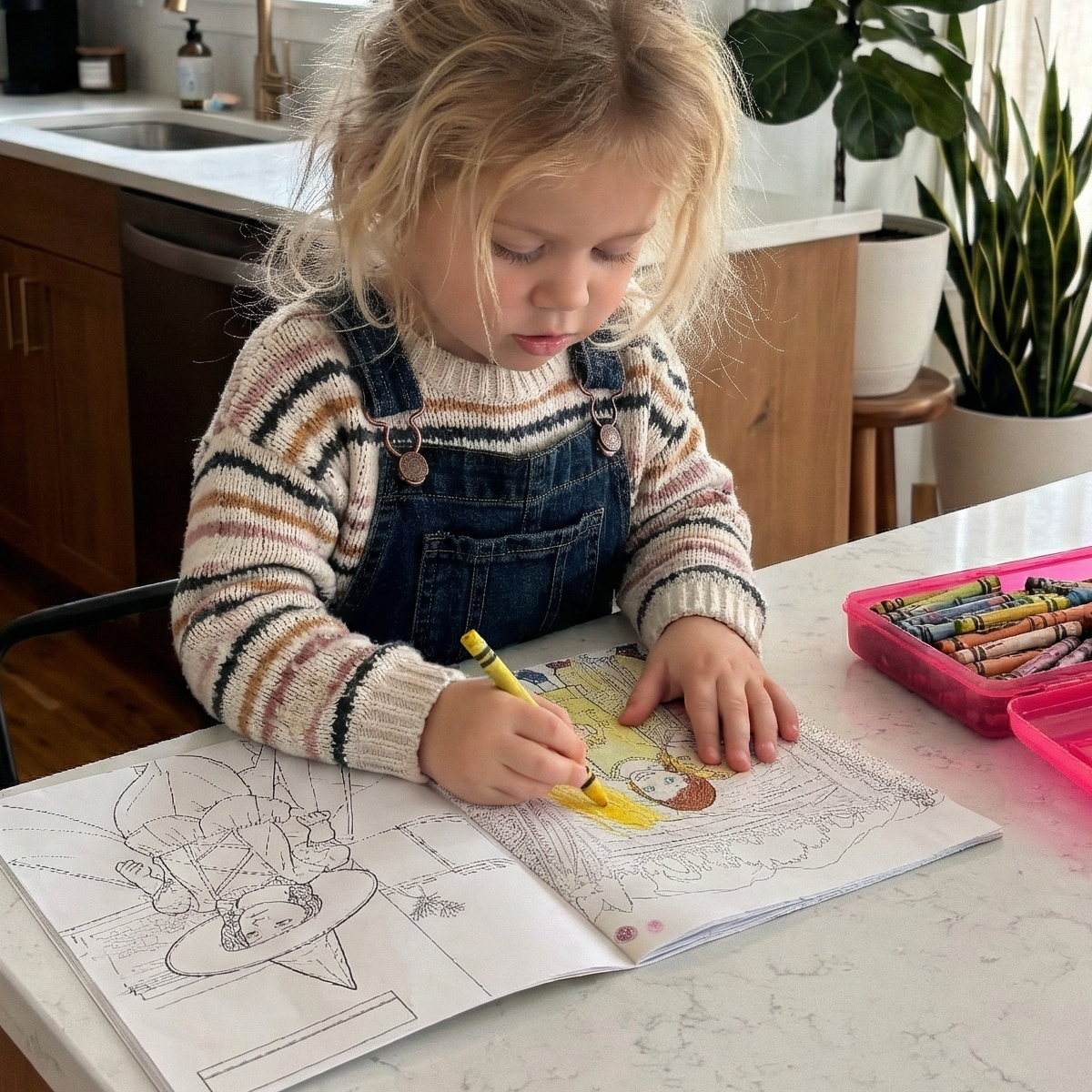
Memory Doodle is a premium storytelling service that transforms your favorite family snapshots into beautiful, custom-bound coloring books....
- Instant Peace: Enjoy 30–60 minutes of quiet, screen-free focus while your child explores their creativity.
- The "Look, It’s Me!" Moment: Boost your child’s confidence by making them the hero of their very own book.
- Meaningful Gifting: Easily share the joy with your inner circle using our simple digital gift codes.
Frequently Asked Questions
What if I find coloring or journaling boring compared to my phone?
How long does it take for the doomscrolling urge to fade?
Can I use an e-reader, or is physical paper always better for sleep?
How do I choose which photos to use for a custom coloring book?