

- The research is real Structured coloring — especially mandala patterns — measurably reduces state anxiety in adults, with benefits appearing in as little as 20 minutes.
- Photo-based coloring adds a second layer Coloring your own family memories activates positive memory recall alongside the motor-focus effect, giving you two calming mechanisms at once.
- It's a tool, not a cure Coloring works best as a consistent, low-friction habit — not a replacement for therapy or medication, but a genuinely effective complement to both.
- 15 minutes is enough to start You don't need an hour or a special setup — keeping supplies visible and using them at high-anxiety moments is what makes the habit stick.

The Short Answer: Yes — But Let's Look at the Evidence
Adult coloring does reduce anxiety, and it's backed by published research. Nancy Curry and colleagues found that structured coloring — particularly mandala patterns — measurably lowered state anxiety in adults after just 20 minutes. The effect is real, repeatable, and accessible to anyone with a pack of colored pencils.
If you're Googling this at 11pm, half-awake on the couch after getting the kids down, you probably don't need a lecture. You need a straight answer. So here it is: the research is solid, the bar to entry is low, and you don't need to be artistic to get the benefit.
What we're going to do here is look at the actual studies — not just headlines — and break down why coloring works, what types work best, and whether it's worth your time as a busy mom who already has seventeen other things on her mental to-do list. We'll also look at how photo-based coloring adds something that plain mandalas can't.
Let's start with the science.
What Does the Research Actually Say About Coloring and Anxiety?
Studies published in the Art Therapy: Journal of the American Art Therapy Association show that structured coloring reduces state anxiety — meaning the anxious feeling you're experiencing right now, not a long-term condition. Nancy Curry's research specifically found that mandala coloring outperformed free-form drawing and blank pages in anxiety reduction, with participants reporting lower anxiety after 20 minutes.
The phrase "state anxiety" matters here. It refers to the temporary, situational kind — the racing thoughts at bedtime, the chest tightness on a Sunday night, the low hum of stress that just won't quiet down. This is different from clinical anxiety disorder, and it's what most of us are actually dealing with day-to-day.
Curry's research compared three conditions: coloring a mandala, coloring a plaid pattern, and coloring a blank sheet. Both the mandala and the plaid outperformed the blank sheet. But the mandala group showed the most significant drop in anxiety scores. The structure mattered. The boundaries and repetition of the pattern gave the brain just enough to focus on — without being overwhelming.
A separate study in the same journal by Holt and Kaiser found measurable physiological changes — not just self-reported feelings — after coloring sessions. Participants showed changes in cortisol levels and heart rate that aligned with a relaxation response.
Twenty minutes. That's the threshold most studies used. And most participants saw a benefit within that window.
That's not a huge ask.
Most people start coloring when they're already deep in anxiety — which is actually the harder time to begin. Research on habit formation suggests the better approach is to start your coloring session *before* the high-anxiety window hits. If Sunday evenings are your worst time, try opening the book at 7pm, not 9pm. You're not treating anxiety once it's spiked; you're preventing the spike. That 30-minute buffer makes a noticeable difference in how quickly the calm sets in.
Why Does Coloring Work? The Science Behind the Calm

Coloring activates the parasympathetic nervous system — the "rest and digest" counterpart to the fight-or-flight response — through repetitive, focused hand movements. It occupies the brain's worry centers just enough to interrupt anxious thought loops, without requiring the mental effort of learning a new skill.
Think about what your brain is doing when you're anxious. It's looping. Replaying the conversation. Running through tomorrow's logistics. Catastrophizing. The problem isn't that your brain is active — it's that it's spinning on nothing useful.
Coloring gives it something to do. A gentle task. The decision of which color to use next, the small motor effort of staying within a line — these are just demanding enough to interrupt the loop without adding more stress.
Researchers sometimes describe this as a "flow-adjacent" state. It's not full flow (you're not losing track of time building something complex), but you're focused enough that the rumination quiets down.
This mechanism is similar to what happens with knitting, gardening, and walking — activities that many people intuitively turn to when they're stressed. All of them involve repetitive movement, a mild focus requirement, and very low stakes. Nobody's judging your color choices.
The bilateral hand movement aspect is worth noting too. Using both hands — even just holding a book with one and coloring with the other — has been associated with calming effects, similar to what's observed in EMDR therapy, which uses bilateral stimulation as part of its anxiety-reduction protocol.
The real advantage over, say, meditation? You don't need to train yourself to do it. There's no "am I doing it right?" anxiety layered on top of your existing anxiety. You just color.
Is Photo-Based Coloring More Effective Than Mandalas?
The published research focuses on mandalas and structured patterns — those are what's been studied in controlled settings. Photo-based coloring hasn't been directly compared in clinical trials. But the evidence suggests it activates an additional calming mechanism: emotional grounding through positive memory, which works alongside the motor-focus effect mandalas provide.
Here's the distinction that matters. When you color a mandala, your brain is doing one thing: focusing on a repetitive motor task. That's genuinely useful. But when you color a photo from last summer's beach trip — your kids digging in the sand, your mom laughing at the dinner table — something else happens alongside it.
Positive autobiographical memory retrieval has its own documented effect on mood and anxiety. Research published in Clinical Psychological Science (Speer, Bhanji, and Delgado, 2014) found that recalling specific positive memories activates reward-related brain regions and measurably reduces negative affect. When you're coloring your own family photo, you're doing both things at once: the motor task and the memory retrieval.
It's not that mandalas don't work. They absolutely do, and for some people, the abstract pattern is actually preferable — there's no emotional weight, no grief mixed in with the good memories. That's a real and valid point. A mandala is emotionally neutral by design.
But for moms who want a tool that also feels connected to something meaningful — who want those 20 minutes to feel like more than just stress management — a coloring book made from your own family photos gives you both.
If you're looking for a gift that does the same for a grandmother or a friend going through a hard season, a personalized coloring book made from real family photos is worth a look — and it's one of the more thoughtful ways to give someone an anxiety-relief tool that also feels like a keepsake. That combination is hard to find.
Memory Doodle Custom Coloring Book
"Colored pencils (not markers — better for fine detail and shading)"
Learn More →How Do Different Coloring Methods Compare for Anxiety Relief?
Before we get into practical tips for making coloring work in your actual life, here's a quick look at how the main options stack up across the criteria that actually matter for anxiety relief.
| Feature | Photo Coloring Book | Mandala Book | Free Printables |
|---|---|---|---|
| Anxiety reduction (motor focus) | Yes — repetitive coloring task calms nervous system | Yes — most-studied method for state anxiety reduction | Yes — same motor mechanism applies |
| Emotional grounding (memory layer) | Strong — your own memories activate positive recall | None — abstract patterns are emotionally neutral | None — generic images have no personal connection |
| Cost | One-time purchase (~$30–$50) | Typically $10–$20 per book | Free — printable from any device |
| Repeat engagement | High — familiar faces keep it interesting across many sessions | Moderate — patterns become repetitive over time | Low — generic images feel disposable |
| Gift value / keepsake quality | High — saves as a family heirloom, not just an activity | Low — not personal, easily replaced | None — single-use paper, not a keepsake |
| Availability (ready tonight) | No — ships in 5–7 business days | Yes — available in most bookstores and online | Yes — print immediately at home |
How Do You Actually Use Coloring for Anxiety? A Realistic Guide

The research supports benefits starting at 15–20 minutes, and you don't need a dedicated studio or special supplies. The key is reducing friction — keeping your supplies accessible — and using coloring at the moments when anxiety is most likely to spike, not just when you remember it exists.
Most articles about adult coloring for anxiety make it sound like you need a whole ritual. Candles, herbal tea, complete silence, an hour of uninterrupted time. If you have that, wonderful. But if you're a mom, you probably don't.
Here's what actually matters:
- Keep your supplies visible. A coloring book and a cup of colored pencils sitting on the kitchen counter will get used. Tucked in a drawer, they'll be forgotten. Friction is the enemy of habit.
- Use the natural pause points. Right after the kids go to bed. During the 20 minutes before school pickup. Sunday evening before the week starts. These are your highest-anxiety windows — and the most useful times to intervene.
- Phone goes face-down. Not across the room, not off — just face-down. You're not going full digital detox; you're just buying your brain 15 minutes without an interruption trigger.
- You don't need to finish a page. Some people find that leaving a page half-done and coming back to it is actually more relaxing — there's no completion pressure, no grade. Color until you feel a shift, then stop.
One thing the research does suggest: consistency matters more than duration. Twenty minutes three times a week likely does more than one 90-minute session on a Sunday. Your nervous system learns to expect the reset.
And about supplies — you genuinely don't need anything expensive. Basic colored pencils work fine. If you want to go deeper, here's what to have on hand:
- Colored pencils (not markers). Pencils give you more control and work better with photo-derived line art where shading adds to the image. Markers bleed and flatten detail.
- A book printed on thick paper. This matters more than it sounds. Thin paper tears under pencil pressure and bleeds with markers. If you're investing in a personalized coloring book, make sure it's printed on artist-grade stock — the kind you can lean into.
- Good lighting. Obvious, but often forgotten. Straining to see fine lines in dim light adds tension rather than removing it.
The 15-minute window is genuinely enough to shift your nervous system's baseline. You don't need to carve out an hour you don't have.
One detail worth knowing: if you're choosing a photo-based coloring book specifically for anxiety relief, close-up photos convert to line art more cleanly than wide landscape shots. A photo of your kids' faces around a birthday cake will produce a cleaner, more satisfying page to color than a distant beach scene. The recognition effect — seeing familiar faces in the line art — is also stronger with close-ups, which intensifies the memory-retrieval benefit.
For anyone thinking about this as a gift — for a friend going through a stressful season, a new mom, or a grandmother who would love something to do with her grandkids' faces on the pages — this guide to personalized keepsake gifts is a genuinely useful read before you order.
One honest limitation: a custom coloring book takes 5–7 business days to ship, so it's not a last-minute solution. If you need something tonight, start with a free printable mandala page — plenty of free options exist online — and order the personalized version for the longer-term habit.
That's the thing about anxiety tools: the best one is the one you'll actually use.
- Backed by published research — not just wellness trend claims
- Adds emotional grounding through personal memory, which generic coloring books can't replicate
- Artist-grade paper handles colored pencils, markers, and even young children without tearing
- Functions as a keepsake long after the coloring is done — pages become family artifacts
- Accessible to any skill level — no artistic ability required for real anxiety benefits
- Ships in 5–7 business days — not a solution for tonight's anxiety spike
- Not every photo converts to clean line art — close-up faces work best; distant or dark photos may produce less detailed pages
Frequently Asked Questions
Want an anxiety-relief tool that also becomes a family keepsake?
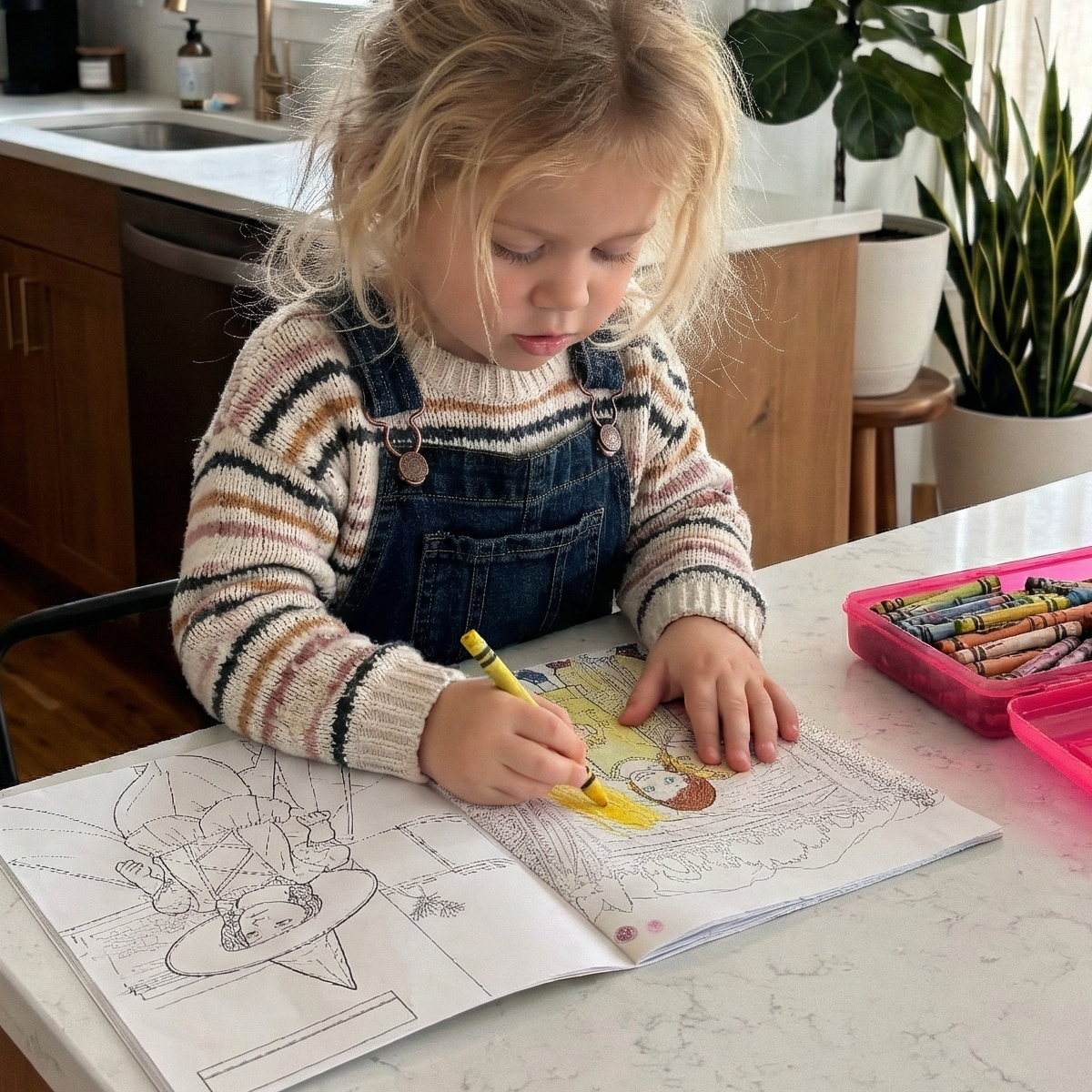
Memory Doodle is a premium storytelling service that transforms your favorite family snapshots into beautiful, custom-bound coloring books....
- Instant Peace: Enjoy 30–60 minutes of quiet, screen-free focus while your child explores their creativity.
- The "Look, It’s Me!" Moment: Boost your child’s confidence by making them the hero of their very own book.
- Meaningful Gifting: Easily share the joy with your inner circle using our simple digital gift codes.
Frequently Asked Questions
How long do I need to color before I feel less anxious?
Is coloring as effective as meditation for anxiety?
What type of coloring is best for anxiety — mandalas, nature scenes, or photos?
Can coloring replace therapy or medication for anxiety?