

- It's a Skill, Not a Trait Independent play is learned through small, repeated practice, not something kids either have or don't.
- Milestones Are Age-Based Toddlers manage 5-10 minutes solo, preschoolers 15-20, and early elementary kids can reach 30-45 with practice.
- Ownership Beats Novelty Personalized activities like a photo-based coloring book hold attention longer than generic toys because kids recognize themselves.
- Setup Matters More Than Willpower A friction-free space with fewer choices and clear boundaries does more than any pep talk.

Your kid can't play alone for more than three minutes, and it's not a discipline problem. It's a skill gap. Independent play is a learned ability, the same way tying shoes or riding a bike is — and most kids today simply haven't had the reps.
That gap is why you're exhausted by 4 PM and why "just go play" gets you a blank stare or a meltdown. There's a fix, but it's not the one you've probably already tried.
What Is Independent Play and Why Do Tired Moms Need It?
Independent play is when a child engages with toys, art, or imagination on their own, without an adult directing or entertaining them. It builds focus, problem-solving, and self-soothing skills — and it gives moms real, guilt-free breaks that aren't about neglect, but about growth.
Let's clear up the guilt first, because it's usually what stops this before it starts. Independent play isn't the same as ignoring your kid. It's the opposite, actually. When you set up the conditions for solo play and then step back, you're teaching your child that their own ideas are worth pursuing. That's a confidence skill, not a detachment one.
Dr. Peter Gray, a research psychologist at Boston College who studies play, has written extensively about how unsupervised, self-directed play is where kids build decision-making and emotional regulation — skills that structured, adult-led activities don't teach nearly as well. You can read more about his research through the American Journal of Play, published by Boston College.
Here's what's really going on in your house: kids who are constantly entertained — by tablets, by parents, by structured activities — never get the chance to sit with boredom long enough to move through it. And moving through boredom is exactly where imagination kicks in.
For you, the mom, this isn't a nice-to-have. It's a mental health issue. Constant on-demand entertaining burns you out. Pediatric researchers at the Cleveland Clinic have noted that unstructured play time supports healthy child development while also giving caregivers necessary recovery time — because parenting without any breaks isn't sustainable for anyone.
So the goal isn't to disappear. It's to build a kid who can occupy fifteen, twenty, thirty minutes of their own day — and to build a version of you who isn't running on fumes by dinner.
What Are Realistic Independent Play Milestones by Age?
Toddlers (18 months–3 years) can typically manage 5-10 minutes of independent play. Preschoolers (3-5 years) can stretch to 15-20 minutes. Early elementary kids (6-8 years) can often reach 30-45 minutes with the right setup and practice.
These numbers are averages, not report cards. Some kids are wired for longer stretches of focus early on. Others need more scaffolding no matter their age, and that's temperament, not failure.
A 2-year-old stacking blocks for six minutes and then wandering off isn't quitting. That's a full independent play session for a toddler. If you're expecting toddler-age kids to sit still for thirty minutes, you're setting up both of you for frustration.
The trick is momentum, not magnitude. Start with the time your child can already manage — even if it's just three minutes — and stretch it by a minute or two every few days. Jumping straight from zero to an hour almost always backfires, because the child hasn't built the internal tools to self-direct for that long yet.
One mom I talked to, Rachel, a mother of three in Ohio, said her son went from a two-minute attention span to almost twenty-five minutes over about six weeks — just by adding small chunks of time gradually and not rescuing him the second he got fidgety.
That patience is the whole game.
How Do You Set Up a Friction-Free Play Environment?

A friction-free play space has fewer toy choices, clear visual access to what's available, and a defined physical boundary. Rotating toys every 1-2 weeks and using low, open shelving reduces decision fatigue and helps kids start playing faster and stay longer.
Too many toys is the silent killer of independent play. When a child faces a toy bin overflowing with fifty options, their brain doesn't light up with excitement — it stalls. Psychologists call this choice paralysis, and it's a documented phenomenon well beyond the toy box, but it hits hard with young kids who don't yet have strong decision-making skills.
Try toy rotation. Pack most of the toys away and leave out just 6-8 options at a time, displayed on a low shelf where your child can see and reach everything without asking for help. Swap the selection every week or two. Kids often "rediscover" a toy they'd forgotten about, and that novelty buys you extra minutes of focus.
Next, think about the physical space. A designated quiet corner — a reading nook, a small table, even a blanket fort — gives a clear signal: this is where solo play happens. Kids do better with boundaries they can see, not just ones they're told about.
Visual timers help too, especially for kids who get anxious about "how long" they need to play. A simple sand timer or color-fading clock timer gives a concrete signal without you having to hover and announce updates every two minutes.
If you want a gift that gets used for weeks instead of minutes, here's what actually needs to be in that quiet corner:
This setup work matters most during the roughest parts of the day — especially that late-afternoon stretch when everyone's patience is thin. If you're dealing with the 5 PM meltdown zone specifically, our guide on surviving the witching hour without a tablet digs into that exact window.
What Are the Best Anchor Activities for Deep, Screen-Free Focus?

Anchor activities are open-ended, screen-free tasks that hold a child's attention without adult direction — think coloring, building, or sorting. Personalized tools work faster than generic toys because recognition and ownership pull kids in immediately, extending focus time.
Not every activity is built to hold attention on its own. Screens win short-term because they're designed to grab focus constantly, refreshing stimulation every few seconds. That's exactly why kids struggle to sit with quieter activities after heavy tablet use — their brains have gotten used to that pace of stimulation, and stillness feels boring by comparison.
The fix isn't more stimulation. It's better ownership.
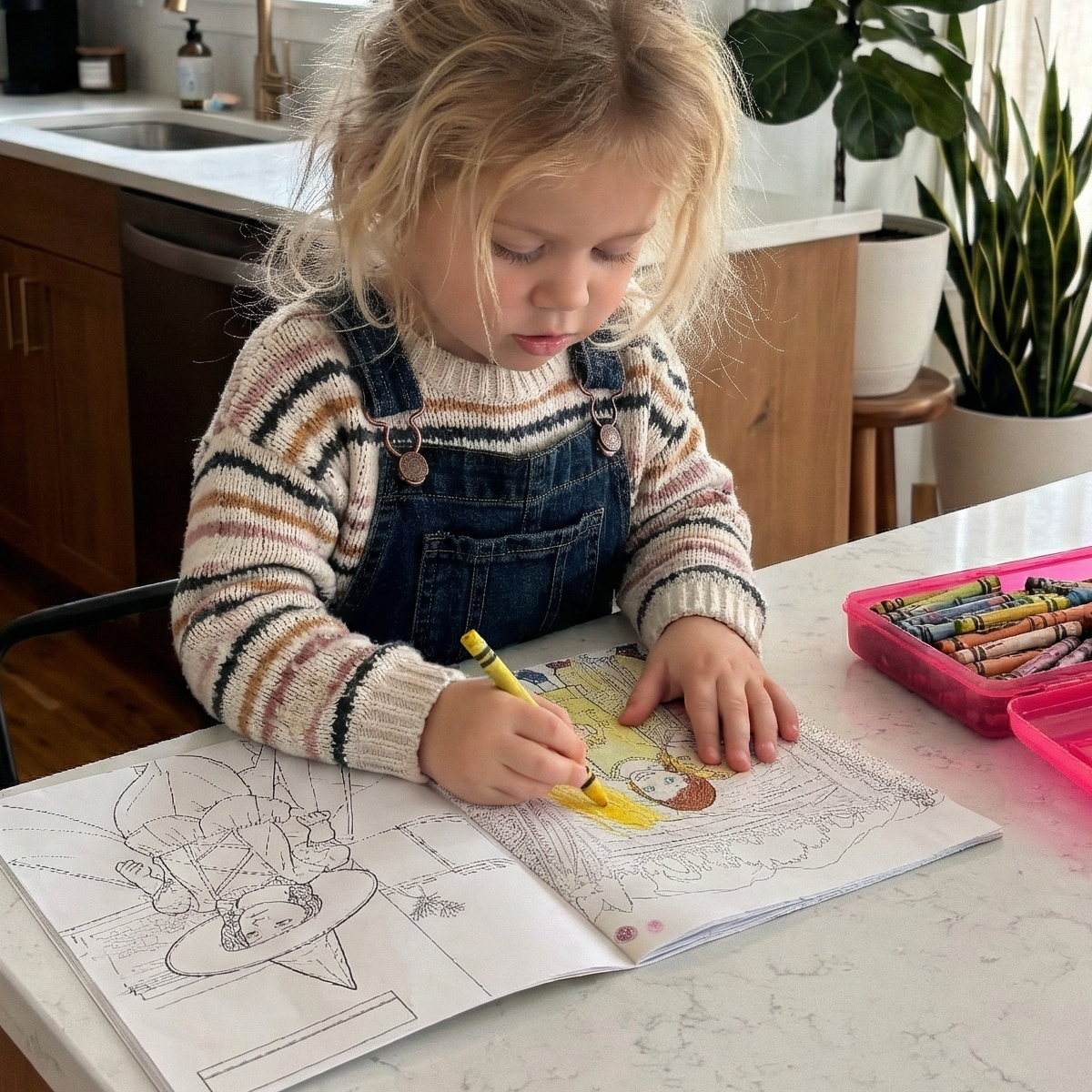
This is where a personalized coloring book pulls ahead of a generic one from the store. When a child opens a coloring book and sees their own face on the page — or their dog, their grandma, their little sister — something shifts. That recognition moment is what keeps kids coloring for twenty, thirty minutes at a stretch, not the crayon quality or the paper weight, though those matter too.
The Memory Doodle Custom Coloring Book takes your own family photos — the messy, flour-covered, candid ones — and turns them into hand-sketched line art your child can color in. Kids recognize themselves right away. That's the hook a blank coloring book from the grocery store just can't offer.
Pick photos where your child is mid-action — mixing batter, splashing in a puddle, mid-laugh — rather than posed smiles. Kids connect faster with images that match their own memory of the moment, and that recognition is what actually stretches their coloring time.
Pair that anchor activity with a couple of sensory options for variety — a bin of dried rice for scooping, some playdough for quiet hands-on time — and you've got a rotation that covers different moods and energy levels without a single screen involved.
If you're hunting for more screen-free options beyond coloring, our piece on ipad alternatives that actually hold kids' attention covers five more ideas worth trying.
Generic printable coloring pages are free, and they're a fine backup for a rainy afternoon. You can find them online with a quick search. But they don't have your kid's face in them, and that recognition factor is the difference between five minutes of interest and thirty.
Here's how the options actually compare once you look past the marketing:
| Feature | Memory Doodle Coloring Book | Generic Store Coloring Book | Free Printable Pages |
|---|---|---|---|
| Recognition factor | Child's own face and family appear on every page | Generic cartoon characters, no personal connection | Generic clip-art style images |
| Cost | Paid, one-time purchase | Low cost, a few dollars | Free |
| Paper quality | Heavy, artist-grade paper with lay-flat binding | Thin paper, often bleeds through | Depends on your home printer and paper |
| Time to attention span drop-off | 20-30+ minutes reported by parents | 5-10 minutes before losing interest | 5-10 minutes, similar to generic books |
| Availability | 5-7 business days to ship | Available same-day at most stores | Instant, print at home |
What Do You Do When Your Kid Says "I'm Bored" or "Play With Me"?
Use the Bridge Strategy: sit and engage for 5 minutes, then gradually physically withdraw while narrating what you're doing ("I'm going to fold laundry while you finish that page"). This eases the transition instead of an abrupt handoff, which is what usually triggers protest.
Kids don't fight independent play because they hate it. They fight the sudden switch. One second you're playing together, the next you've vanished to do dishes, and that whiplash feels like abandonment even when it isn't.
The Bridge Strategy softens that. Sit down, get them started, color one picture together or build the first few blocks. Then start narrating your exit in small steps: "I'm just going to start the dishes, I'll be right in the kitchen." Physical proximity without direct engagement is the bridge between together-time and solo-time.
Sibling squabbles over shared materials are their own beast. If two kids are fighting over the one coloring book, that's not really an independent play problem — it's a sharing problem wearing an independent play costume. Giving each child their own personalized set removes the competition entirely, since nobody's coloring page looks like anyone else's.
Our article on why personalized activity sets work better than forced sharing covers this exact scenario if it's a daily fight in your house.
And if the "I'm bored" chorus starts right as you're trying to make dinner, that's usually a screen-habit issue layered on top. Our guide on reducing screen time without daily battles breaks down how to rebuild that tolerance for stillness over a couple of weeks.
None of this happens overnight.
Honestly, some days will still fall apart. That's normal, not a sign you're doing it wrong.
Before we wrap up, let's be straight about what this looks like in practice — the wins and the honest limits.
- Kids recognize themselves instantly, which extends solo focus time noticeably
- Thick, durable paper holds up to heavy crayon use without bleeding through
- Lay-flat binding makes it easy for toddlers and preschoolers to color without help
- Bonus digital codes let you gift pages to grandparents or cousins easily
- Takes 5-7 business days to ship, so it's not a same-day fix for a meltdown tonight
- Close-up, well-lit photos convert best — busy group shots or dark photos don't translate as cleanly to line art
Conclusion: Reclaiming Peace and Confidence in Your Daily Routine
Start with one anchor activity and one time slot — maybe fifteen minutes after breakfast — and don't touch anything else in your routine yet. Small, boring consistency beats a dramatic overhaul that fizzles out in a week. Track how many minutes your child actually plays solo each day for two weeks; most moms are shocked to see the number climbing before they've even noticed.
Ready to give your kid a screen-free activity that actually holds their attention?
Memory Doodle is a premium storytelling service that transforms your favorite family snapshots into beautiful, custom-bound coloring books....
- Instant Peace: Enjoy 30–60 minutes of quiet, screen-free focus while your child explores their creativity.
- The "Look, It’s Me!" Moment: Boost your child’s confidence by making them the hero of their very own book.
- Meaningful Gifting: Easily share the joy with your inner circle using our simple digital gift codes.