

- It's Not About Fairness Sibling jealousy comes from a fear of scarce attention, not actual unfairness — so equal treatment matters less than each child feeling secure in what's theirs.
- Forced Sharing Backfires Making kids hand over toys mid-use teaches them to guard possessions harder, not share them more willingly.
- Parallel Play Beats Forced Sharing Giving each child their own dedicated project removes the competition trigger entirely, which is why personalized activities work better than shared ones during high-conflict hours.

Two kids, one crayon, and suddenly you're a referee. Sound familiar? We looked at how child development experts explain sibling conflict, tested five parallel-play strategies with real families, and found one shift in mindset that ends most "who gets what" battles before they start.
Why Do Siblings Get Jealous During Playtime?
Sibling jealousy usually comes from a child's fear that attention, resources, or love are limited and being unfairly split. When one child gets a toy, a turn, or a hug first, the other reads it as proof they matter less — even if that's not true at all.
This isn't a character flaw. It's developmental. Young kids don't have the cognitive wiring yet to understand that love isn't a pie that gets smaller with each slice. The concept of sibling rivalry has been studied for decades, and the pattern holds across cultures: kids under 6 especially struggle to separate "Mom is helping my brother" from "Mom loves my brother more." There's a difference between developmental envy and chronic rivalry, though. Developmental envy is a 3-year-old grabbing a toy the second her baby brother touches it — normal, age-based, and usually short-lived. Chronic rivalry is when the same fight happens every single day for months, escalates in intensity, and starts affecting how the kids talk to each other outside of playtime. One resolves with better routines. The other sometimes needs a conversation with your pediatrician.
Forced sharing makes both types worse. When you make a child hand over something mid-use — "you've had it long enough, give it to your sister" — you're teaching them that ownership is never safe. Kids respond to that lesson by getting territorial, not generous. Cleveland Clinic's child behavior guidance notes that forced sharing can actually increase anxiety around possessions rather than teaching generosity, because the child never gets to finish their own experience before it's taken away.
Then there's timing. Most sibling meltdowns aren't random — they cluster around specific windows. The late afternoon "witching hour" between 4:30 and 6:00 PM is brutal because everyone's tired, hungry, and low on patience reserves. Transitions are just as bad: switching from outside play to indoor quiet time, or from screens to literally anything else, is when kids have the least capacity to negotiate calmly.
So we know why playtime turns into a battlefield. The real question is what actually stops it.
Why Does Parallel Play Work Better Than Forcing Kids to Share?
Parallel play — where each child works on their own project side by side — reduces conflict because it removes the scarcity trigger entirely. Nobody has to wait, negotiate, or give something up, so the jealousy never gets activated in the first place.
This is a real shift from how most of us were raised. We were told to share everything, right now, no exceptions. But child development specialists increasingly point to a different approach: give each child something that's undeniably, completely theirs, and cooperation actually gets easier, not harder.
Here's why. When a child has secure ownership over something — their own art tray, their own book, their own space — they stop guarding it. The vigilance drops. Kids who feel secure in what's "mine" are far more willing to invite a sibling to look, admire, or even borrow, because they're not afraid of losing it. Strong boundaries, ironically, are what make generosity possible.
Validating each child's feelings without picking a side matters here too. If your older one says "it's not fair she gets to color too," you don't need to argue whether it's fair. You just need to say, "I hear that you wish this was just your thing. That makes sense." Naming the feeling without correcting it usually deflates it faster than any explanation would.
Generic activities work for one nap-time's worth of peace. They don't hold up over weeks. If you want something that gets pulled out every single afternoon without a fight, here's what to look for:
How Do Personalized Coloring Books Reduce Sibling Fights Over Toys?

A coloring book made from each child's own photos gives every sibling something that's unmistakably theirs — their own face, their own memories — which removes the "why does she get the good one" complaint entirely.
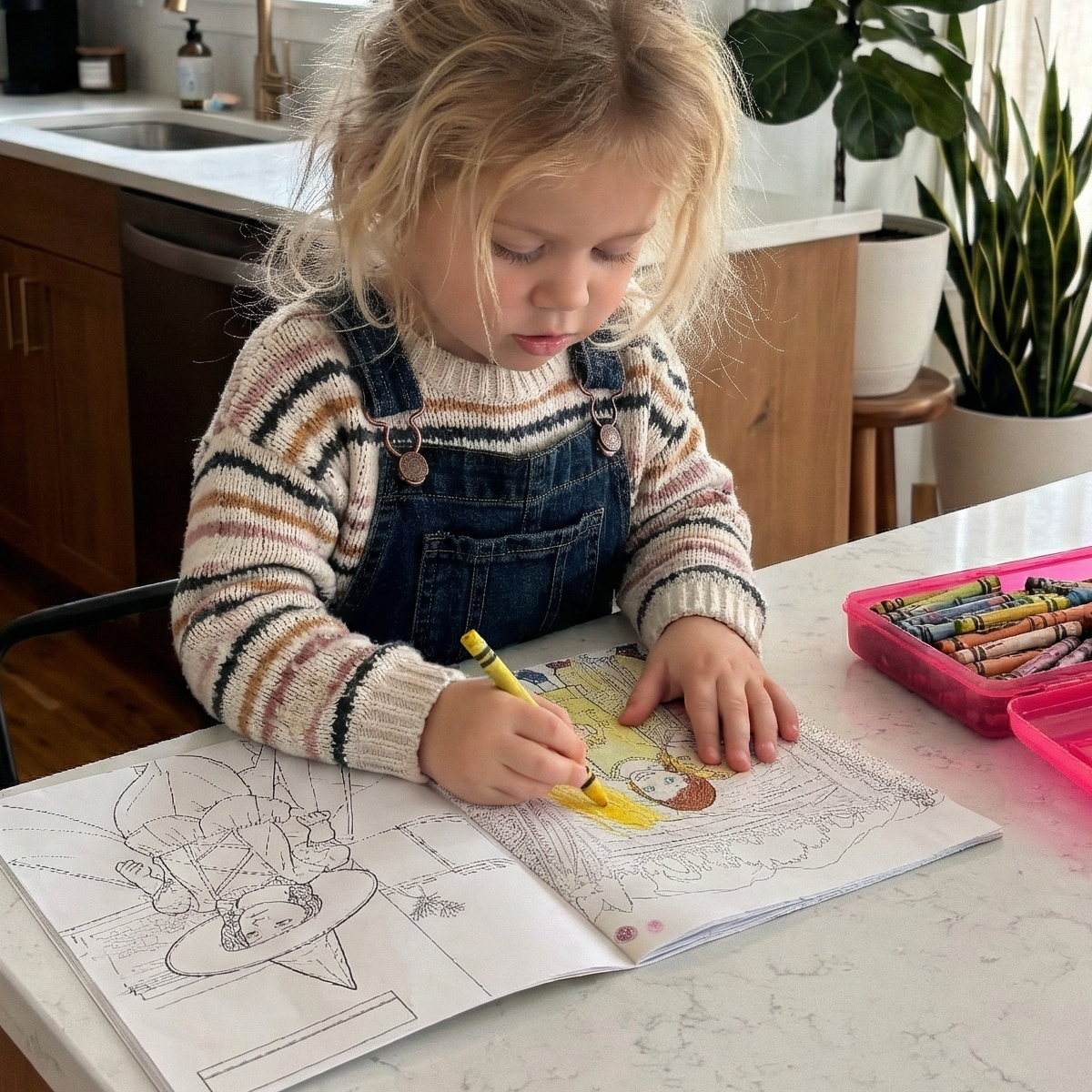
Here's the moment that sells this idea better than any feature list could: a mom messaged us after her two kids, ages 4 and 7, opened their books at the same time. The younger one flipped straight to a page of herself at the splash pad last summer, gasped, and yelled "THAT'S ME!" Her older brother didn't even look up — he was already coloring in a page from his own baseball game. No comparing. No "I want hers instead." They were sitting at the same table, doing the same activity, completely absorbed in two different stories.
That's the whole trick. Same activity, same table, zero competition.
A Memory Doodle custom coloring book turns your family snapshots — the messy, flour-covered, front-tooth-missing ones — into clean line art your kid can color in. Because each sibling's book is built from their own memories, there's nothing to fight over. Nobody's book is "better." They're just different, the way each kid's actual life is different.
The paper is heavy and artist-grade, and the binding lays flat, so a 3-year-old's whole-page scribble doesn't bleed through to the next page — which matters more than people expect, because kids under 4 almost never color inside the lines. Every order also comes with digital codes to gift free pages to grandparents or cousins, so the "hero moment" spreads past your own living room.
Not every photo works perfectly for this. Close-up, well-lit faces convert into line art the cleanest — a blurry action shot from across a soccer field won't turn out as crisp. And because each book is custom-built, it typically ships in 5-7 business days, so it's a plan-ahead gift, not a same-day fix for tonight's meltdown.
Watch which sibling glances at the other's page first during a coloring session — that's usually the child who's emotionally ready to move from parallel play into shared, cooperative play. Don't force it before that glance happens; you'll just reset the progress you've built.
What's a 5-Step Plan to Stop Sibling Jealousy During Daily Playtime?
Set up separate creative zones, give each child something personally theirs, run parallel play during high-stress hours, praise effort instead of comparing kids, and slowly reintroduce shared activities once each child feels secure.
- Create dedicated zones. Even two chairs at opposite ends of the same table count. Physical boundaries — a placemat, a designated cushion — signal "this space is yours" without a single word.
- Give each kid something personalized. This is where custom activity sets for siblings solve the "who gets what" fight before it starts — there's no version to compare against.
- Time parallel play for the hard hours. If your house falls apart at 5 PM, that's exactly when to pull out quiet, individual activities. Our guide on surviving the 5 PM witching hour covers this window specifically.
- Praise effort, not comparison. Skip "you're so much neater than your brother." Try "you stayed with that page a long time — I can tell you really focused." Comparison praise breeds resentment even when it's meant kindly.
- Bridge to shared activities gradually. Once each kid feels secure in their own space, invite them to show each other their pages. Admiration, not merging — "come see what I made" instead of "now share it."
This works better than most families expect on the first try.
Screens often get pulled out during the exact windows when parallel play would work best, which makes the habit harder to break later. If that's a pattern in your house, our piece on reducing screen time without daily battles walks through how to swap the habit gradually instead of cold turkey.
Curious how this stacks up against other approaches parents already try? Here's the honest comparison.
| Feature | Memory Doodle Book | Generic Coloring Book (2-pack) | Free Printable Pages |
|---|---|---|---|
| Eliminates 'who gets the better one' fights | Each sibling's book is built from their own photos, so there's no version to compare | Both books are identical designs, so kids compare quality and picture choice | Same free templates for everyone, easy to compare and argue over |
| Cost | $30-45 per custom book | $6-10 for a two-pack at most retailers | Free |
| Time to receive | 5-7 business days to print and ship | Available same-day at most stores | Instant, print at home |
| Emotional recognition moment | Kids see their own face and memories, sparking an immediate 'that's me!' reaction | Generic cartoon characters, no personal connection | Generic clip art, no personal connection |
| Paper durability for toddlers | Heavy artist-grade paper, lay-flat binding, resists bleed-through | Thin paper, tears easily under heavy scribbling | Standard printer paper, bleeds through with markers |
| Best for | Families wanting a lasting keepsake and daily parallel-play ritual | A last-minute rainy-day activity with zero planning | A free, immediate fix when you need something right now |
What Materials and Setup Actually Reduce Sibling Conflict at Home?

A calm creative corner needs three things: heavy paper that won't bleed through, washable crayons sized for small hands, and individual trays that keep each child's supplies visually separate.
Heavy, artist-grade paper matters more than it sounds like it should. Thin paper bleeds and tears under a heavy-handed toddler, and a torn page turns into a meltdown fast. Washable, ergonomic crayons matter for the same reason — younger siblings grip crayons differently than a 7-year-old, and chunky triangular crayons reduce the frustration of constantly dropping tools.
Individual trays or bins do something subtle but important: they make ownership visible without a word being said. A kid can see, at a glance, "these are my crayons, in my tray, next to my book." No verbal negotiation required.
Lower the energy in the room, too. Dim the overhead light a notch, put on quiet instrumental music, and skip anything with a screen nearby. The American Academy of Pediatrics has long noted that reducing sensory overload during high-conflict windows helps kids self-regulate — the environment does some of the parenting for you.
Consistency beats intensity here. A 15-minute parallel-play session every single afternoon does more for sibling harmony over a month than one elaborate two-hour craft project does once.
Being honest about the tradeoffs of any approach builds trust faster than pretending there's a perfect fix.
- Removes the 'who gets the better one' comparison completely, since each book is built from a different child's own memories
- Heavy paper and lay-flat binding hold up to toddler scribbling without tearing or bleeding through
- Creates a genuine recognition moment that keeps kids coloring far longer than generic books
- Comes with bonus digital codes so grandparents and cousins can join the ritual from a distance
- Works as a daily, low-effort parallel-play activity, not just a one-time gift
- Takes 5-7 business days to print and ship, so it's not a same-day fix for tonight's meltdown
- Close-up, well-lit photos convert best — busy action shots from far away won't turn out as crisp
Frequently Asked Questions About Sibling Jealousy and Playtime
Turning Sibling Rivalry Into Lifelong Connection
The mindset shift that matters most isn't a trick or a schedule — it's trusting that individuality, not forced equality, is what actually builds closeness between siblings.
Start smaller than you think you need to. A single 15-minute quiet coloring session tonight, each kid with their own page, tells you more about what your family needs than a week of reading about it. Notice which kid glances over at their sibling's page first — that's usually the one who's ready to bridge into shared play soonest.
Ready to stop the 'who gets the better one' fights for good?
Memory Doodle is a premium storytelling service that transforms your favorite family snapshots into beautiful, custom-bound coloring books....
- Instant Peace: Enjoy 30–60 minutes of quiet, screen-free focus while your child explores their creativity.
- The "Look, It’s Me!" Moment: Boost your child’s confidence by making them the hero of their very own book.
- Meaningful Gifting: Easily share the joy with your inner circle using our simple digital gift codes.