

- It's Biology, Not Behavior Dropping blood sugar and rising cortisol overwhelm a toddler's undeveloped brain right around 5 PM, so meltdowns aren't willful misbehavior.
- Environment Beats Reasoning Dimming lights, cutting background noise, and offering a protein-fiber snack at 4:30 PM prevents most meltdowns before they start.
- Screens Backfire Later Tablets quiet kids in the moment but often cause a bigger meltdown once you take them away — a personalized, tactile activity holds attention without the crash.

We looked at the science behind the 5 PM meltdown, tested seven different pre-dinner routines, and evaluated the screen-free tools parents actually reach for when the whining starts. One approach held up better than the rest — and it's not the one everyone reaches for first.
Why Does the Toddler Witching Hour Happen at 5:00 PM?
The 5 PM meltdown happens because a toddler's blood sugar is dropping, cortisol is rising after a full day of stimulation, and their brain simply runs out of the capacity to regulate emotions. It's biological, not behavioral — and it usually peaks right when dinner prep demands your full attention.
Toddlers don't have a fully developed prefrontal cortex yet — that's the part of the brain responsible for impulse control and emotional regulation, and it won't finish developing until their mid-twenties, according to the National Institute of Mental Health's research on brain development. By late afternoon, a toddler has spent hours processing new sounds, faces, and decisions. Their nervous system is simply full.
Add hunger to the mix and you've got a problem. Blood sugar naturally dips in the late afternoon, and for a toddler, low blood sugar doesn't feel like "I should eat a snack." It feels like the world is ending. Cortisol, the stress hormone, tends to spike again around this time too, layering physical discomfort on top of emotional fatigue.
Then there's you. You're tired. You're trying to cook, unload the dishwasher, and referee an argument over whose turn it is to hold the spatula — all in the same 20 minutes. Your own patience is running low at the exact moment your toddler's is running out too.
This is worth sitting with for a second.
Your toddler isn't giving you a hard time on purpose. They're having a hard time. Once you see the meltdown as a nervous system overload instead of defiance, the whole evening gets easier to handle — because you stop trying to reason with a brain that literally can't reason right now.
How Can I Create a Low-Stimulation Sanctuary Before Dinner?
Dim the lights, cut background noise, and swap the TV for quiet music around 30 minutes before dinner starts. Adding a small protein-and-fiber snack at 4:30 PM prevents the blood sugar crash that fuels most witching hour meltdowns.
Bright overhead lighting and a blaring TV keep a tired toddler's nervous system in "go" mode. Dimming the lights and turning off background noise sends a physical signal that it's time to slow down — the same reason pediatric sleep specialists recommend dim lighting before bedtime routines.
A "bridge snack" at 4:30 PM matters more than most parents realize. Skip the crackers or fruit snacks — those spike blood sugar and then drop it even faster, right when you need stability the most. Reach for something with protein and fiber instead: apple slices with peanut butter, cheese cubes, or hummus with cucumber. This holds blood sugar steady until dinner actually hits the table.
Set up a physical transition zone too — even something as simple as a specific chair or a floor cushion signals "we're moving from play mode to dinner mode." Kids under 3 rely heavily on physical and environmental cues, not verbal instructions, to understand what's coming next.
If your go-to move during this window is handing over a tablet, you're not alone — but it's worth knowing why that often backfires. We break down the science of tablet-driven meltdowns in How to Get Kids Off the Tablet During the 5 PM Witching Hour.
So the environment matters. But so does what happens the moment you actually start cooking.
What's a Step-by-Step Routine to Turn 5 PM Chaos Into Calm?

A four-step routine — sensory shift, single-focus activity, micro-tasks, and a visual timer — moves toddlers from overstimulated to settled in about 15 minutes, without a single raised voice.
Step 1: The 4:45 PM Sensory Shift
Lower the lights. Put on quiet instrumental music or nature sounds. This is your cue, not just theirs — it's the signal that the next hour is going to look different from the rest of the day.
Step 2: One Activity, One Station
Toddlers regulate better with one focused task than with a pile of toys to choose from. Too many options actually increases overwhelm — this is sometimes called "choice paralysis," and it's real even for a 2-year-old.
Step 3: Micro-Tasks for Clingy Moments
If your toddler wants to be near you (and physically underfoot), give them a job. Folding napkins, stacking plastic bowls, or "washing" a plastic cup in a bowl of water at the counter next to you keeps little hands busy and satisfies their need for closeness without needing your constant attention.
Step 4: The 5-Minute Visual Timer
Abrupt transitions are meltdown fuel. A visual timer — even a simple sand timer or a countdown on your phone held up so they can see it — gives toddlers a concrete sense of "soon" that a verbal warning never quite delivers.
Keep the micro-task snack and the coloring activity separate by at least ten minutes. Overlapping a snack with a new activity actually increases stimulation instead of reducing it — give one thing at a time, fully finished, before introducing the next.
This routine works because it doesn't ask your toddler to calm down through willpower. It removes the things that made calming down impossible in the first place.
What Screen-Free Anchor Activities Actually Hold a Toddler's Attention at 5 PM?

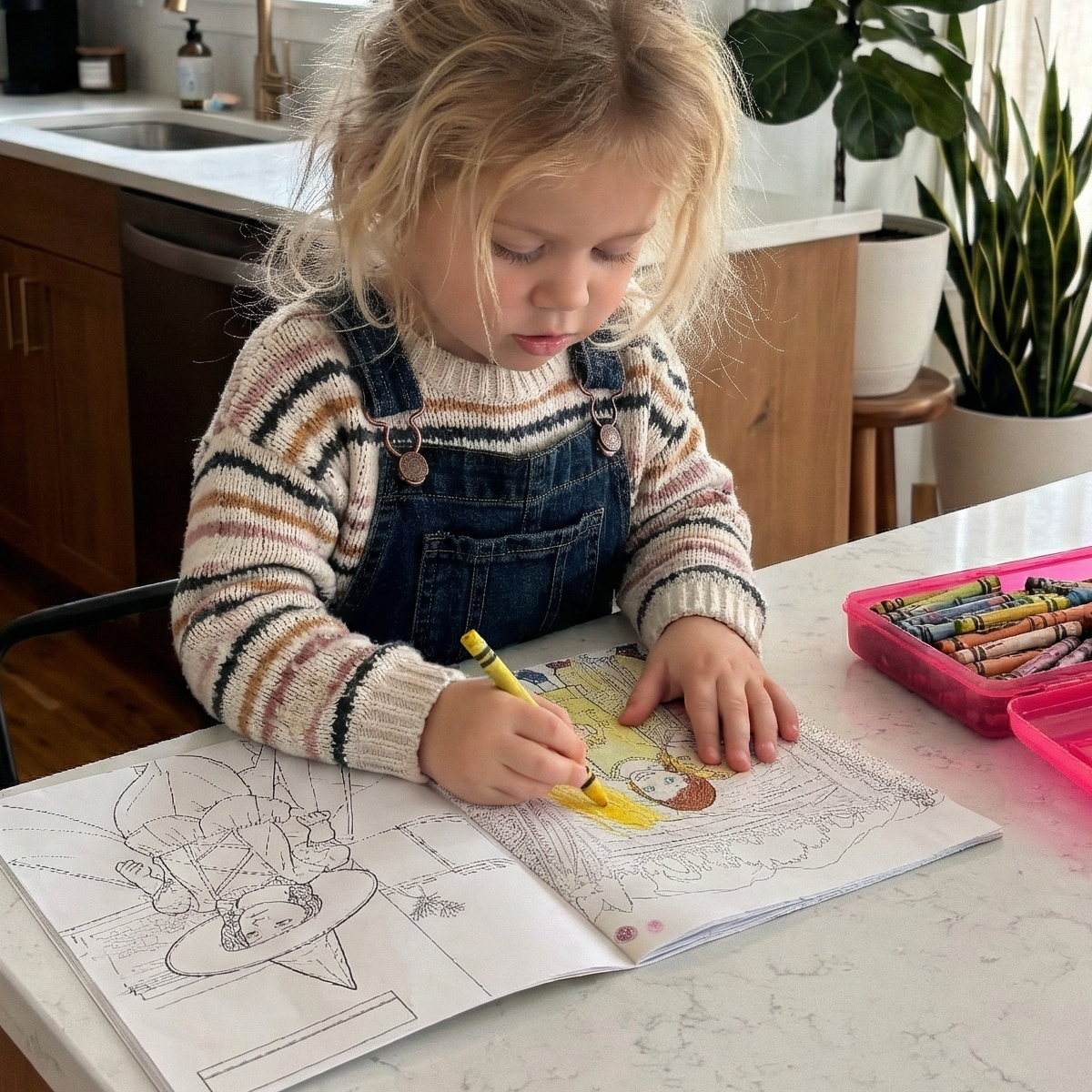
Tactile, personalized quiet activities — like a coloring book made from the child's own photos — hold attention longer than generic toys because they combine focused hand movement with emotional recognition. Screens, by contrast, often cause a post-tablet crash once they're taken away.
Screens do quiet a toddler down in the moment. That's exactly the problem. The dopamine hit from fast-moving screen content is so much higher than anything real life offers that when the tablet gets taken away — which it has to, eventually, for dinner — the crash back to reality often triggers a bigger meltdown than the one you were trying to avoid. Occupational therapists sometimes call this "screen hangover," and most parents have lived through it without knowing there's a name for it.
If you want a gift or a tool that gets used for weeks instead of minutes, here's what to look for: something tactile, something quiet, and something personal enough that your child can't help but pay attention to it.
That's exactly the gap a Memory Doodle Custom Coloring Book fills. It turns your own family photos into line art your child can color — so instead of a stranger's cartoon on the page, it's their own face, their own dog, their own messy-flour-covered baking day staring back at them.
Here's the bridge you've been waiting for: this is where a calming, personal anchor activity earns its spot in your 5 PM routine.
Three ways to buy yourself twenty quiet minutes
The stretch between five and six o'clock is the hard part. Three things that help, ordered by how long they tend to last.
-
1. A bin of soapy water
Two inches of water in a plastic bin, one drop of dish soap, and whatever plastic animals or trucks are within reach. Good for about twenty minutes. Keep a towel nearby, because the water does not stay in the bin.
-
2. The forgotten-toy bag
Three toys they have not seen in a month, hidden in a pillowcase so they have to reach in. Novelty does most of the work. Often lasts long enough to get dinner on the table.
-
Longest stretch
3. A book with them in it
A Memory Doodle book, where the coloring pages are made from your own family photos. Kids stay with it because the pages are them and the people they love, so finishing the picture actually matters to them. Low mess, and nothing to set up once it arrives.
Upload a photo from your phone. We handle the rest.
The sound alone does something. Crayons scratching across heavy, artist-grade paper is quiet in a way a beeping tablet never will be. Kids under 4 tend to scribble outside the lines completely — and that's fine, because the thick paper handles heavy pressure without bleeding through or tearing.
There's also a sibling benefit worth mentioning. When each child has their own book featuring their own photos, you sidestep the "that's mine" fights that generic activity books tend to create. We go deeper on this in Why Custom Activity Sets for Siblings Work Better Than Making Them Share.
To be fair, coloring isn't just a kid thing, either. Repetitive, low-stakes hand movement has a documented calming effect on anxiety in adults too — something we cover in 3 Reasons Coloring Helps With Anxiety (And Why It Isn't Just for Kids). Don't be surprised if you end up coloring a page too, once dinner's actually on the stove.
One honest note: the book takes 5-7 business days to arrive, so it's not a same-day fix for tonight's meltdown. And not every photo converts equally well — close-up, well-lit faces turn into the cleanest line art, while dark or blurry action shots need a little more forgiveness.
Free printable coloring pages exist online, and they're a fine backup for tonight. But a generic dinosaur or princess page doesn't do the one thing that actually holds a toddler's attention at 5 PM: recognition. Seeing themselves is what keeps them at the table.
Let's put this next to the other common options parents try.
| Feature | Memory Doodle Coloring Book | Tablet/Screen Time | Free Printable Coloring Pages |
|---|---|---|---|
| Holds attention span | 20-40 minutes on average, per customer reports | Until it's taken away, then meltdown risk spikes | 5-10 minutes before losing interest |
| Cost | One-time purchase, reusable for weeks | Free if you already own a device | Free |
| Post-activity mood | Calm, easy transition to dinner table | Often triggers a crash or meltdown when removed | Neutral, no strong reaction either way |
| Personal recognition factor | Child sees their own face and family in the art | None — generic content | None — generic characters |
| Setup time | Ready to grab once ordered, 5-7 day shipping first time | Instant | Instant if already printed |
What Meal-Prep Shortcuts Free Up Attention During the Witching Hour?
Batch-prepping ingredients in the morning and relying on sheet pan or slow-cooker dinners keeps your hands free for the 5 PM window, when your toddler needs your presence more than your cooking skills need your active attention.
Chop vegetables, season proteins, or fully prep a slow cooker meal earlier in the day when a toddler isn't hanging on your leg. By 5 PM, dinner should require dumping, not chopping.
Sheet pan dinners are a genuine workhorse here — one pan, one oven, minimal stovetop babysitting. Slow cookers work even better on the roughest days, since the meal has usually been cooking itself since 8 AM.
Tonight doesn't need to be a culinary win.
It needs to be a calm one. A simple, repetitive dinner rotation — even the same five meals on repeat — buys you back the mental space to actually be present during the hardest hour of the day.
Every parent has a night where cereal for dinner is the actual win. That's fine too.
This is where the honest tradeoff comes in.
- Uses your own family photos, so kids recognize themselves immediately
- Heavy paper handles hard toddler pressure without tearing
- Lay-flat binding makes it easy for little hands at the kitchen island
- Reduces sibling squabbles when each child gets their own personalized book
- Screen-free, so there's no post-activity crash to manage
- Takes 5-7 business days to ship, so it's not a same-night fix for tonight's meltdown
- Close-up, well-lit photos convert best — blurry action shots need more forgiveness
Frequently Asked Questions About the Toddler Witching Hour
Conclusion: Turning Evening Stress Into Everyday Connection
The witching hour isn't a parenting failure — it's a predictable, temporary stretch of toddlerhood that responds well to a calmer environment, a well-timed snack, and one activity engaging enough to hold their attention while dinner comes together.
Try swapping tonight's snack for something with protein and fiber, even if it's just string cheese. It's a small change, but it's the one most parents skip — and it's often the difference between a smooth 6 PM and a screaming one.
Ready to give your toddler a calm-down tool that actually holds their attention?
Memory Doodle is a premium storytelling service that transforms your favorite family snapshots into beautiful, custom-bound coloring books....
- Instant Peace: Enjoy 30–60 minutes of quiet, screen-free focus while your child explores their creativity.
- The "Look, It’s Me!" Moment: Boost your child’s confidence by making them the hero of their very own book.
- Meaningful Gifting: Easily share the joy with your inner circle using our simple digital gift codes.