

- Mental load is management, not chores It's the remembering, anticipating, and tracking work that never turns off, even when the physical chore is shared.
- Fix it with a system, not willpower Brain dump every task, then sort it into Delete, Delegate, Automate, or Simplify.
- Hand over whole domains, not tasks Full ownership of laundry or school forms sticks; a one-off chore assignment doesn't.
- Screen-free quiet time gives real recovery A child absorbed in a personalized coloring book buys you uninterrupted minutes without the screen-off meltdown.

You know that feeling when someone asks "what's wrong?" and you can't even answer because your brain is a browser with 47 tabs open? That's mental load. And most days, nobody even knows it's running.
What Is the Mom Mental Load and Why Is It So Exhausting?
Mom mental load is the invisible, non-stop mental work of managing a household — remembering, planning, anticipating, and tracking everyone's needs, not just doing the physical chores. It's exhausting because it never turns off, even while you sleep, drive, or sit in a meeting.
There's a real difference between doing a task and owning it. Your partner might load the dishwasher — great, that's execution. But did he notice you were low on dish soap three days ago and add it to the list? Did he remember your daughter's shoe size changed and she needs new sneakers before soccer starts? That's management. And management is the part that lives rent-free in your head 24/7.
Sociologist Allison Daminger's research on cognitive labor (published through Harvard's sociology department) breaks the mental load into four stages: anticipating needs, identifying options, deciding, and monitoring the outcome. Most households split the "doing" fairly evenly these days. It's the anticipating and monitoring that stays lopsided — and that's the part that causes decision fatigue.
Decision fatigue is real. The American Psychological Association has documented how constant small decisions deplete the same mental resource, leaving you with less patience and clarity by 5 p.m. than you had at 7 a.m.
That's not a personality flaw.
That's just how brains work under constant tracking.
How Can You Audit and Reduce Your Invisible Workload Step-by-Step?

You reduce your invisible workload by doing a full brain dump of every recurring task, then sorting each one into Delete, Delegate, Automate, or Simplify. This turns a fuzzy, overwhelming cloud of "stuff I'm responsible for" into a concrete list you can actually act on.
Step 1: Do a Total Brain Dump
Grab paper — not your phone, paper — and write down every single recurring task you're mentally tracking. Birthday gifts for nieces. Refilling the kids' vitamins. Scheduling the dentist. Remembering grandma's anniversary. Don't organize it yet. Just get it out of your head and onto the page.
Most moms who do this for the first time fill two full pages in under ten minutes.
Step 2: Apply Delete, Delegate, Automate, Simplify
Now go line by line and ask: can this be deleted entirely (does the birthday card really need to be handmade)? Can it be delegated? Can it be automated (grocery subscriptions, auto-pay bills, recurring calendar reminders)? Or can it just be simplified (same five dinners on rotation instead of a new menu every week)?
Step 3: Hand Over Entire Domains, Not Tasks
This is the step most families skip, and it's the one that actually works. Instead of asking your partner to "help with laundry," hand over the entire laundry domain — sorting, washing, folding, AND noticing when the kids are out of clean socks. Full ownership, not a task list you still have to check.
Step 4: Build Sanity-Saver Routines for Daily Stress Triggers
Certain windows of the day — morning rush, dinner prep, bedtime — are predictable pressure points. Build a routine around them once, and you stop re-deciding how to handle them every single day.
If you want a sanity-saver that actually gets used for weeks instead of minutes, here's what to look for: something screen-free, something the kids can do without you hovering, and something that feels special enough that they choose it over a tablet.
Memory Doodle Custom Coloring Book for Uninterrupted Daily Quiet Time
A custom coloring book made from your own family photos turns your kid into the actual star of the page. That recognition moment — a child seeing their own face, their own dog, their own birthday cake in line-art form — is what keeps them coloring long after a generic coloring book gets abandoned on day two.
One mom told us her four-year-old asked to "read" his Memory Doodle book every single night for three weeks straight, because it had a page of him and his grandpa fishing last summer.
That's the kind of focus you can't manufacture with store-bought pages.
The books are printed on heavy, artist-grade paper with lay-flat binding, so little hands can actually color comfortably without the pages snapping shut. There's something genuinely calming about the sound of crayon on thick paper — no beeping, no autoplay, no flashing colors demanding attention. Just quiet, focused scribbling.
Kids under 4 tend to scribble across the whole page rather than staying in the lines, and that's fine — the paper is thick enough that it won't bleed through or tear.
One honest note: not every photo converts perfectly into line art. Close-up, well-lit faces work best, so it helps to pick a handful of your clearest favorites rather than blurry action shots. And since each book is made to order, it takes some lead time to ship — so it's not a same-day fix for tonight's witching hour, but it's worth planning ahead for.
Maternal mental health specialists often note that moms track tasks in their heads because writing them down feels like admitting they can't handle it all. Flip that script: a written brain dump isn't a failure log, it's the exact tool that frees up working memory for actual presence with your kids.
Expert Insight & Materials List: Essential Tools to Automate Household Peace
Maternal mental health specialists consistently point to one core habit for reducing overwhelm: setting cognitive boundaries around what actually requires your attention today versus what can wait. Releasing perfectionism — deciding that "good enough" dinner or "slightly wrinkled" laundry is fine — frees up real mental space, not just theoretical space.
If you want a genuinely low-friction home, here are three tools worth setting up once:
- A visual schedule board in the kitchen or entryway — a simple whiteboard or magnetic calendar the whole family can see, so you're not the only one holding the schedule in your head.
- An automated grocery subscription for the staples you buy every single week (diapers, coffee, dish soap) so restocking stops being a decision at all.
- A dedicated Quiet-Time Basket — a basket kept in the living room stocked with crayons, colored pencils, and a Memory Doodle coloring book your child can grab independently, no negotiation required.
For more on replacing screen battles with calmer alternatives, our guide on how to reduce screen time for kids walks through this in more depth. And if coloring sounds like something you'd benefit from too, not just your kids, this piece on why coloring helps with anxiety isn't just for kids is worth a read.
Let's talk about the hardest hour of the day — because it deserves its own strategy.
How Do You Tame the 5 PM Witching Hour Without Defaulting to Screens?

You tame the 5 p.m. witching hour by having one low-supervision, high-engagement activity ready before the chaos starts — not by scrambling for a solution in the moment. Blood sugar dips, accumulated fatigue, and a parent's own depleted patience all collide around dinnertime, which is exactly why it feels harder than any other hour of the day.
The Cleveland Clinic has noted that both children and adults experience a natural energy dip in the late afternoon tied to circadian rhythm, which is part of why 5 p.m. feels uniquely awful in households with young kids.
Screens work in the moment, but they create their own problem: the meltdown when it's time to turn them off. A tactile, story-driven activity doesn't have that same cliff-edge ending. Kids can put down crayons and walk to the dinner table far more easily than they can put down a tablet mid-show.
Custom, photo-based coloring pages work especially well here because the story is already personal — there's no explaining plot or characters. A page of "you and mom baking cookies last week" doesn't need setup. Your child recognizes it instantly and starts coloring.
Curious about other tools for this exact window of the day? We wrote a dedicated guide on getting kids off the tablet during the 5 p.m. witching hour with more tactical ideas.
Now, if your family has questions that need fast, direct answers, here they are.
| Feature | Memory Doodle Coloring Book | Tablet/Screen Time | Free Printable Coloring Pages |
|---|---|---|---|
| Personalized to your child | Made from your own family photos | Generic content, not personal | Generic characters, not personal |
| Cost per use | One-time purchase, reused for weeks | Free with existing device | Free |
| Ends without a meltdown | Child stops naturally when finished | Often triggers a fight to turn off | Child stops naturally when finished |
| Setup time required | None once basket is stocked | None, just hand over device | Requires printing and ink |
| Screen-free | Yes | No | Yes |
- Turns favorite family photos into a keepsake kids actually want to color
- Heavy paper and lay-flat binding hold up to enthusiastic scribbling
- Keeps kids independently engaged during high-stress hours like dinner prep
- Comes with digital codes to gift free pages to family
- Made-to-order, so it needs lead time and isn't a same-day fix
- Close-up, well-lit photos convert best — blurry action shots don't work as well
Rapid-Fire Q&A: Fast Answers for Reducing Mom Mental Load
What Is the Quickest Way to Reduce Mom Mental Load Right Now?
The quickest fix is dropping one non-essential expectation today and automating one recurring task this week. You don't need a full life overhaul. Cancel the homemade cupcakes, buy the store ones. Set up auto-pay on one bill. Small wins compound fast.
How Can I Stop Feeling Like the Manager of My Home?
You stop feeling like the manager by shifting from delegating individual tasks to handing over entire domains of ownership. When your partner owns "all things related to school forms" — not just the task you assigned this week — the mental tracking moves off your plate for good, not just temporarily.
Does Screen-Free Quiet Time Actually Help Moms Reset?
Yes — screen-free quiet time gives moms measurable cognitive recovery by cutting out the noise, flashing lights, and constant negotiation that screens tend to bring. A child independently absorbed in a coloring book means genuine, uninterrupted minutes for you — no refereeing, no volume battles, no "five more minutes" negotiations.
Is It Selfish to Ask for a Break From Mental Load Tasks?
No, asking for a break isn't selfish — it's a boundary, and boundaries are what make sustainable parenting possible. Chronic, unaddressed mental load is linked to higher stress and burnout symptoms, according to the American Psychological Association's ongoing stress research. Protecting your own bandwidth protects your whole family long-term.
One small, non-obvious tip nobody tells you: keep your Quiet-Time Basket somewhere visible, not tucked in a closet. Kids reach for what they can see — out of sight really does mean out of mind, even for a five-year-old.
Ready to buy back a few quiet minutes of your day?
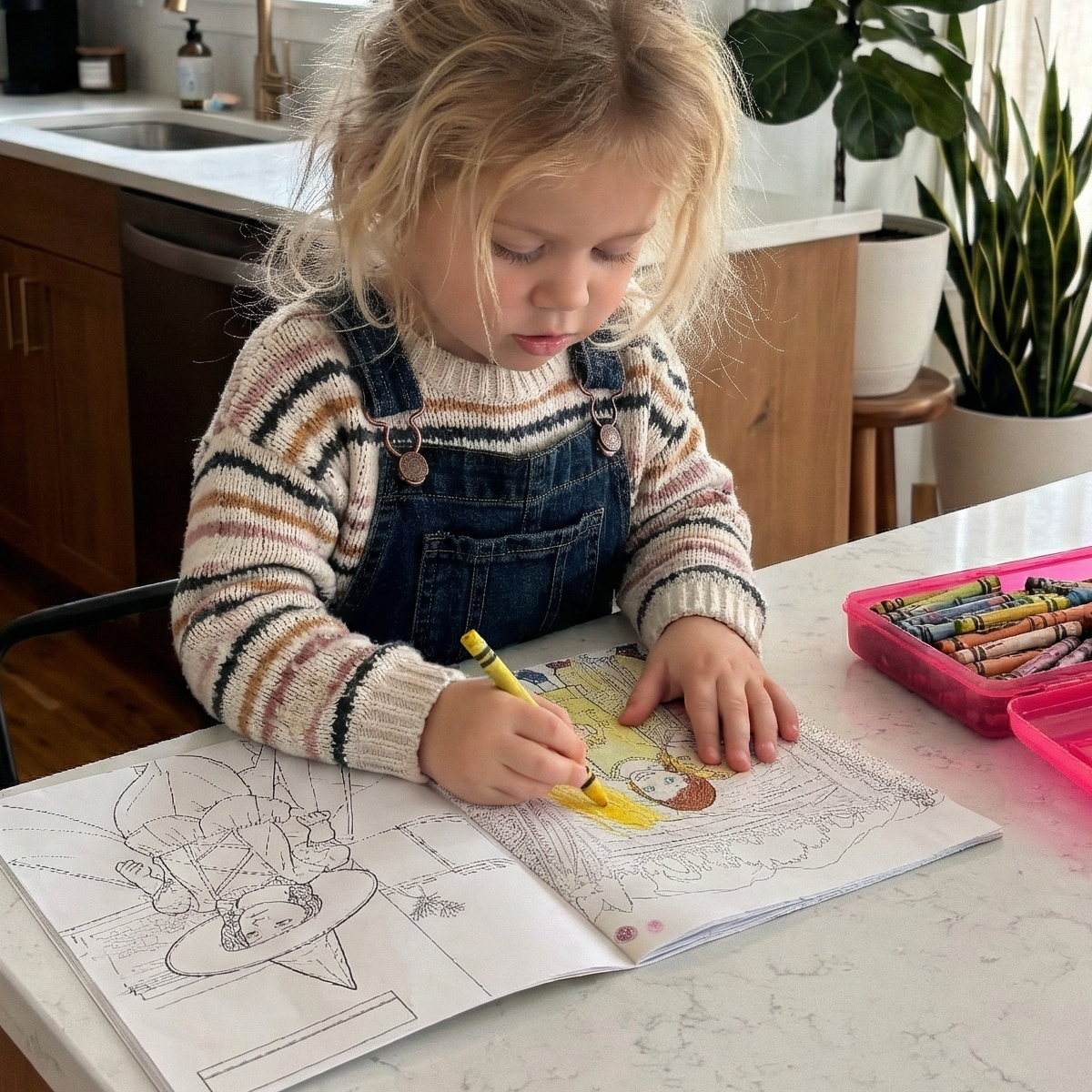
Memory Doodle is a premium storytelling service that transforms your favorite family snapshots into beautiful, custom-bound coloring books....
- Instant Peace: Enjoy 30–60 minutes of quiet, screen-free focus while your child explores their creativity.
- The "Look, It’s Me!" Moment: Boost your child’s confidence by making them the hero of their very own book.
- Meaningful Gifting: Easily share the joy with your inner circle using our simple digital gift codes.