

- Sharing isn't the problem Young children's brains aren't wired for easy turn-taking — so forcing them to share one activity set practically guarantees a fight.
- Same-but-different is the fix Giving each sibling their own custom activity set — one that's clearly and personally theirs — eliminates the ownership disputes before they start.
- Personalization keeps them engaged Kids color their own Memory Doodle books for far longer than generic pages because they recognize themselves and their family on every page.
- Plan ahead for shipping These books take 5–7 business days to arrive, so they're not a last-minute fix — but they're worth the wait.

Why Is Sibling Sharing So Hard — Even When Kids Love Each Other?
Sharing is cognitively hard for young children because the prefrontal cortex — the part of the brain responsible for impulse control and turn-taking — doesn't fully develop until around age 25. For kids under 7, "sharing" isn't selfishness. It's neurology. Expecting them to cheerfully hand over something they love is, developmentally speaking, asking a lot.
You've planned the perfect rainy afternoon. Coloring books, markers, a snack on the table. Two minutes in, someone has grabbed someone else's red crayon, and it's full-on meltdown.
Sound familiar?
According to the American Academy of Pediatrics, sibling conflict is one of the most common stressors in family life — and it peaks during the preschool and early elementary years, exactly when kids are spending the most time together at home. The fights aren't random. They follow a pattern: a shared resource, a perceived imbalance, and a meltdown that erases whatever peace you'd hoped to find.
The thing parents don't always realize? The activity itself isn't the problem. The shared-ness of it is.
When two kids reach into the same bin, they don't just grab a toy. They begin a silent audit: Who got more? Who got the better one? Is this fair? It happens almost instantly, and it's completely involuntary. Researchers who study sibling dynamics and resource competition have found that even when resources are objectively equal, children as young as three will perceive inequity if items aren't clearly differentiated as "mine."
That's the real problem.
It's not that your kids don't love each other. It's that a shared coloring book — with one set of markers between them — puts them in direct competition before a single page is colored.
Why Does the "Just Share" Approach Keep Backfiring?
Telling siblings to share a single activity set doesn't eliminate competition — it just delays it by a few minutes. When kids can't clearly identify what belongs to them, they spend more mental energy on ownership disputes than on the activity itself, which defeats the purpose entirely.
Every parent has tried the "just share, it's enough for both of you" approach. And every parent knows how that usually goes.
Here's why it fails, and it's not about manners. When two children share one coloring book, they're constantly negotiating — whose turn is it to pick a page, who gets to use the blue marker, who finished "the good one" first. That negotiation is exhausting for kids. It pulls their attention away from the creative work and keeps them in a state of low-grade alertness, watching for unfairness.
Child development researchers call this "resource scarcity stress." Even when there's technically enough of something, the lack of clear ownership triggers a threat response. The result is what most parents just call the 5 PM witching hour: cranky kids, short fuses, and a parent trying to referee a dispute about who colored the dog wrong.
Generic toy bins make this worse. When everything is "ours," nothing feels safe. Your daughter can't build her puzzle in peace if her brother is allowed to grab pieces at will. Your son can't feel proud of his drawing if his sister is allowed to color over it. The communal setup that's meant to teach sharing actually teaches anxiety.
And the mental load on you? Real. Constant. Every minor dispute requires a parent to show up, assess the situation, make a judgment call, and somehow satisfy both children while pretending to also cook dinner.
If you're deep in this season of life, this piece on handling the 5 PM witching hour has some practical ideas that actually work.
When setting up parallel play zones for siblings, place the workspaces so that each child has their back or side to the other, rather than facing them directly. Face-to-face setups invite comparison and eye contact that triggers competition. Side-by-side or slightly angled away keeps kids aware of each other's presence — which is comforting — without putting what the other child is doing in their direct line of sight.
What Actually Works: Free and Low-Cost Ways to Reduce Sharing Fights

The most effective free fix is simple physical separation of supplies: each child gets their own clearly labeled set of crayons, their own paper, and their own dedicated workspace — even if those spaces are just a few feet apart. This single change eliminates most ownership disputes without any new purchases.
Before we talk about anything you'd buy, here are things you can do today that genuinely help.
Give each child their own labeled supply box. A small pencil box or Ziploc bag with their name on it changes everything. What's inside is theirs. They don't have to share it, defend it, or watch it carefully. This alone can reduce crayon-related conflict by an embarrassing amount.
Set up parallel play zones. Side-by-side but separate. Two little tables, or two ends of the same table, each with their own supplies. Kids can still see each other and chat — they're not isolated — but there's a clear physical boundary that signals: this is mine, that is yours.
Use free printable coloring pages to give each child their own stack. You can find thousands of them online. They won't have your kid's face on them, but they're a real option, and they're free. Print enough that each child has their own pile and doesn't need to negotiate for pages.
These methods work for a few hours. They reduce the immediate flash points. But they run into a ceiling pretty quickly: generic pages don't hold a child's attention for long, and a shared character coloring book with no personal connection gets abandoned by day two.
That's where the "same-but-different" idea becomes genuinely powerful.
If you want a gift that gets used for weeks instead of minutes, here's what to look for: something each child can own completely, something connected to their real life, and something that doesn't need to be negotiated over.
Memory Doodle Custom Coloring Book
"Individual labeled crayon box (one per child)"
Learn More →How Do Custom Activity Sets Actually Stop Sibling Rivalry?
Custom activity sets work because they replace the scarcity dynamic with an abundance one: each child has something that is entirely, undeniably theirs. When a coloring book has your daughter's face on the cover and your son's face on his, there is no dispute about whose is whose — and no temptation to grab the other one.
This is the shift that changes everything: from "ours" to "mine and also yours."
Child development experts use the phrase "parallel play" to describe the golden window — usually between ages 2 and 6 — when children play alongside each other without truly playing together. They're absorbing social cues, regulating emotions, and building attention spans. But parallel play requires a sense of safety. Each child needs to feel that their space and their materials are secure.
Custom activity sets create that safety automatically.
When each child has a personalized coloring book made from photos of their own adventures — their birthday party, their favorite park, their dog — the book becomes a self-contained world. Your daughter isn't interested in your son's book because it's about his life, not hers. And he feels the same about hers. There's no competition, because the items are genuinely different.
Parents who've tried this approach often describe the same moment: both kids sitting at the table, crayons moving, nobody talking, just... coloring. That quiet is not an accident. It's what happens when children feel settled in their own space.
Here's a look at how different approaches actually compare:
| Feature | Memory Doodle | Generic Coloring Book | Free Printable Pages |
|---|---|---|---|
| Personalized to each child | Yes — each book features that child's real photos | No — same characters for every child | No — but you can print multiples of the same page |
| Eliminates ownership disputes | Yes — completely different books, no temptation to swap | No — siblings often want the same page or character | Partially — printing identical sets helps, but kids may still compare |
| Sustained engagement time | 45–60 minutes reported by most parents | 15–20 minutes before interest drops | 10–15 minutes per session on average |
| Cost | Paid — priced as a premium keepsake | Low — a few dollars at most retailers | Free — print from home anytime |
| Paper quality for small hands | Heavy artist-grade, lay-flat binding, no bleed-through | Thin newsprint-style paper, bleeds with markers | Standard printer paper — acceptable for crayons only |
| Keepsake value after completion | High — families save finished books for years | Low — usually discarded after use | None — loose pages rarely kept |
| Speed to use | 5–7 business days shipping — not immediate | Available same day at any store | Immediate — print and use in minutes |
How Does Memory Doodle Turn Sibling Rivalry Into Individual Masterpieces?
Memory Doodle turns your real family photos into custom coloring books — one for each child, featuring their own memories, their own face, their own story. Because each book is completely unique to that child, siblings have no reason to reach for each other's copy, which makes it one of the most effective parallel-play tools for multi-child households.
Here's what makes it different from a generic coloring book: the moment a child sees themselves on the page.
That recognition — "that's me, that's our dog, that's grandma's kitchen" — does something a cartoon character never can. It pulls kids in and keeps them there. Parents consistently report that their kids color their Memory Doodle books for 45 minutes to an hour at a stretch, which is remarkable for any screen-free activity.
The books are printed on heavy, artist-grade paper with lay-flat binding, which matters more than it sounds. Little hands push hard when they color. Pages that buckle or bleed through are frustrating, and frustrated kids don't stay quiet. The thick paper handles everything from careful watercolor pencil work to enthusiastic crayon scribbling — and kids under 4 who color over the whole page in one frantic sweep will find the paper holds up without bleeding through to the next page.
One honest note: the books take 5–7 business days to ship, so this isn't a solution for tomorrow morning's chaos. Plan a week ahead, especially around holidays.
And if you're wondering whether to order one big shared book or individual ones for each child — individual, always. The whole point is that each child owns their own story. A shared book just recreates the problem you're trying to solve.
For families with a new sibling on the way, this guide on gifts for big brothers shows how a personalized book can ease that transition beautifully.
How Do You Set Up Custom Activity Sets in Your Daily Routine?

The most effective time to introduce custom activity sets is during a predictable high-stress window — dinner prep, afternoon slump, or the hour before bed. Setting up individual creative zones at the same time each day trains kids to expect that this is their calm, independent activity time.
Routine is everything. Kids who know "this is my coloring time" settle faster than kids who are handed something new and expected to figure it out mid-meltdown.
Pick your window — most parents choose 5 to 6 PM, when dinner needs to happen and patience is thin on all sides. Set up the same spots every day. Each child's book goes in their spot. Their own box of crayons goes beside it. No shared supplies. No trading required.
A few things that make this work smoothly:
- Their own crayon box — not shared, not borrowed. A basic 24-pack each is plenty. Label the boxes with their names.
- A dedicated placemat or tray for each child's workspace, even if they're sitting at the same table. The physical boundary does real psychological work.
- Their Memory Doodle book, stored in their spot between sessions so it stays associated with their space.
When they work side by side without grabbing or arguing — even for ten minutes — say something specific: "I noticed you both colored your whole pages without fighting. That felt good, didn't it?" Naming the success matters more than rewarding it with a treat.
The goal isn't silence forever. It's teaching kids that sitting near someone while doing your own thing can feel good. That skill — being together without competing — is one they'll use their whole lives.
Why Do Personalized Keepsakes Last Longer Than Plastic Toys?
Personalized keepsakes outlast plastic toys because they're tied to identity and memory, not novelty. A child who sees themselves on the pages of a coloring book doesn't outgrow it — they grow into it, returning to color new pages as their skills develop over months.
Think about how fast a new toy loses its shine. There's usually a 20-minute window of genuine engagement, then it joins the pile. That's not a parenting failure. It's just how novelty works for developing brains — new stimulus, brief excitement, quick habituation.
Personalized items work differently. A child who sees their own face, their own family, their own memories on the pages of a book isn't experiencing novelty. They're experiencing recognition. And recognition doesn't fade the same way.
There's also the pride factor. Kids treat things that are "mine" with more care than things that are "ours." A finished page in a book that belongs entirely to them gets shown off, talked about, and often saved. Parents have described keeping completed Memory Doodle books on shelves alongside baby photos — a genuine snapshot of who their child was at that age, preserved in the lines they chose to color.
That's not something a plastic toy does.
If you're thinking about screen-free alternatives to tablets, personalized coloring books consistently rank at the top for sustained engagement — not because of any one feature, but because the child is literally the main character.
Chatbooks makes a lovely photo book you can flip through together, and it's a genuinely sweet keepsake. But it's meant for looking at, not interacting with. The difference between a photo book and a coloring book is the difference between watching a movie and being in one.
Here's an honest look at what Memory Doodle gets right — and where it has room to grow:
- Completely eliminates 'whose is whose' disputes — each book is unmistakably one child's
- Personalized photos create genuine, sustained engagement far beyond generic coloring books
- Heavy, lay-flat paper handles enthusiastic little-kid coloring without bleeding or buckling
- Completed books become real keepsakes families save alongside baby photos
- Digital gift codes let grandparents and relatives join in from anywhere
- Takes 5–7 business days to ship — not a solution for tomorrow's witching hour
- Not every photo converts perfectly — close-up faces with clear lighting work best
One more thing worth knowing: every Memory Doodle order comes with digital codes that let you instantly gift free printable coloring pages to grandparents, aunts, and uncles. So grandma in another state can print a page, color it, and mail it back. That detail sounds small. Ask any grandmother how it feels to receive a colored picture in the mail, and then tell me it's small.
Ready to give each child something that's completely, peacefully theirs?
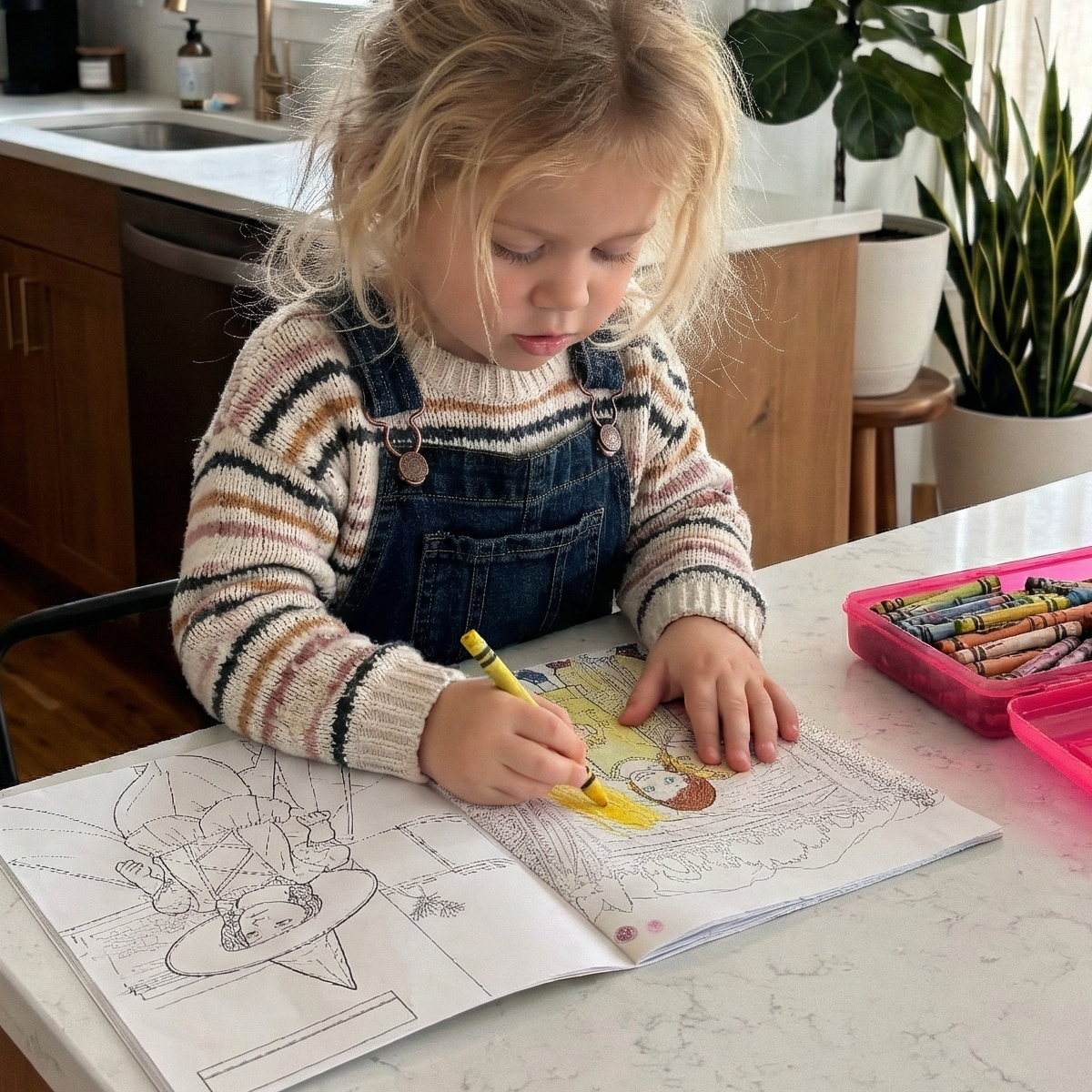
Memory Doodle is a premium storytelling service that transforms your favorite family snapshots into beautiful, custom-bound coloring books....
- Instant Peace: Enjoy 30–60 minutes of quiet, screen-free focus while your child explores their creativity.
- The "Look, It’s Me!" Moment: Boost your child’s confidence by making them the hero of their very own book.
- Meaningful Gifting: Easily share the joy with your inner circle using our simple digital gift codes.
Frequently Asked Questions
What if my kids still try to grab each other's custom books?
How do I choose photos so one child doesn't feel jealous of the other's book?
Is it better to order one big book or individual books for each child?
What age can children start benefiting from personalized activity sets?