

- Yes, it works with real-life photos Candid shots — messy faces, backyard adventures, holiday chaos — convert into clean line art better than stiff studio portraits.
- Professional services beat DIY apps Heavy artist-grade paper and lay-flat binding make a book kids actually use for weeks, not a stapled printout they abandon by day two.
- Kids color longer when they see themselves The recognition moment — a child spotting their own face on page one — is what turns a coloring book into a keepsake they return to again and again.
- Plan ahead for shipping Quality books take 5–7 business days to arrive, so this is not a last-minute gift — order early for birthdays and holidays.

Can I really make a custom coloring book from my own photos?
Yes — you absolutely can, and it's easier than you'd think. Your everyday photos, even the blurry birthday cake ones and the muddy backyard shots, can be turned into clean, colorable line art. The result is a bound coloring book that features your actual child, your actual family, your actual life — not a generic cartoon character.
Think about your camera roll for a second. How many photos do you have sitting in there? The one of your daughter covered in flour from that pancake disaster. Your grandson mid-leap off the back porch. That holiday dinner where everyone was laughing at something nobody can remember anymore.
Those photos are digital clutter right now. They live on a phone. Nobody prints them. Nobody frames them all. But they're actually some of the best storytelling material you have.
A custom coloring book turns that clutter into something physical. Something a child can hold, open, and color. And here's what makes it different from a store-bought book — the moment a kid opens to page one and sees their own face staring back at them as a drawing, they stop. They look up at you. And then they grab the nearest crayon.
That recognition moment is everything.
Child development researchers at the ZERO TO THREE organization note that young children build identity and self-concept through seeing themselves represented in stories and play. A coloring book where your child is the main character isn't just fun — it genuinely reinforces their sense of belonging.
For grandmothers especially, this kind of gift carries a weight that no toy can match. You're not sending something from a shelf. You're sending a piece of shared memory — wrapped in paper they can color over and over again.
If you want a gift that gets used for weeks instead of minutes, here's what to look for:
Memory Doodle Custom Coloring Book
"Washable markers (for mess-free coloring on heavy paper)"
Learn More →How do you actually make a custom coloring book from your photos?

The process has five steps: choose your photos, upload them to a service, let artists convert them to line art, customize your details (like a title or dedication), and then approve the final pages before it goes to print. A quality service typically ships within 5–7 business days.
Step 1: Curate your "chaos to canvas" collection
Don't overthink the photo selection. The best coloring books aren't built from posed portraits — they're built from the real stuff. A kid with spaghetti on their face. A grandparent and grandchild building a sandcastle. A dog photobombing a family photo.
Aim for photos where the main subject is clearly separated from the background. Busy backgrounds (think: crowded birthday parties) are harder to convert cleanly. Simple backgrounds — a backyard, a kitchen counter, a plain wall — give the artists more to work with.
Plan for roughly 10–20 photos for a full book, though some services let you go higher. Pick shots that tell a story together, not just individual favorites.
Step 2: Upload your memories
A dedicated service like Memory Doodle makes this part simple. You upload your photos through their website, select your book options, and they handle the rest. No app to download. No software to figure out.
This matters more than people expect. The uploading experience should feel like sending photos to a friend, not troubleshooting a design program at 11pm.
Step 3: The transformation — real line art, not a phone filter
This is where professional services earn their price. The photos go through a careful conversion process that creates clean, hand-sketched-feeling line art — the kind a child can actually color inside without frustration. The lines are clear, the detail is intentional, and faces are recognizable.
This is not the same as running a photo through an Instagram filter. A filter flattens everything. Good line art for coloring requires judgment — which details to keep, which to simplify, where to place the lines so small hands can follow them.
When selecting photos for a coloring book, avoid shots taken from directly above or below — bird's-eye and worm's-eye angles make faces hard to recognize once they're converted to line art. Straight-on or slight three-quarter angle shots (the classic school photo angle) consistently produce the clearest, most recognizable drawings. If you're photographing a child specifically for a coloring book, crouch down to their eye level and shoot in natural window light — those two adjustments alone will dramatically improve the final line art.
Step 4: Add the personal details
Most services let you add a title (something like "Emma's Big Adventure" or "Grandma and Me") and a short dedication on the inside cover. Don't skip this. That handwritten-style dedication is often what makes grandparents cry and kids feel like the whole book was made just for them.
Because it was.
Step 5: Quality check before it prints
A good service shows you a preview of every page before it ships. Look at each one carefully. Check that faces are recognizable. Make sure the lines are clean enough for a child to color. If something looks off, a quality service will fix it before printing.
The paper matters here too. Artist-grade, heavy-weight paper handles crayons, colored pencils, and even washable markers without bleeding through to the next page. Thin printer paper can't survive a determined five-year-old with a Crayola marker.
What kind of photos work best for a custom coloring book?
Photos with clear subjects, simple backgrounds, and good natural light convert best. Close-up faces and single-subject shots consistently produce the cleanest line art. Candid, real-life photos — not staged portraits — tend to make for more joyful coloring pages, because they capture expressions that posed photos never do.
Here's a counterintuitive truth: the messy photos are often the best ones.
A pristine studio portrait looks beautiful, but it's stiff. The drawing ends up stiff too. But a photo of a kid mid-laugh, mid-jump, or mid-mess? That energy translates into the line art. Kids color those pages with more enthusiasm because there's something alive in the drawing.
| Feature | Memory Doodle | DIY App + Home Printer | Photo Book (e.g., Chatbooks) |
|---|---|---|---|
| Line art quality | Clean, hand-sketched-feel line art optimized for coloring | Edge-detection filters — often muddy or over-detailed | N/A — photo books show photos, not drawings |
| Paper quality | Heavy artist-grade paper, marker-safe | Standard printer paper — bleeds, crinkles | Glossy photo paper — not meant for coloring |
| Binding | Lay-flat binding for easy small-hand use | Stapled or unbound — falls apart quickly | Perfect-bound or saddle-stitched — pages don't lie flat |
| Cost | Paid service (see pricing) | Near zero — just printer ink and paper | Mid-range — similar to a photo book |
| Time investment (parent) | ~20 minutes to upload and customize | 3–5 hours of app troubleshooting and DIY assembly | ~30 minutes to arrange and order |
| Durability | Built to last — heirloom quality | Fragile — paper tears, staples bend | Durable cover, but not designed for active use |
| Interactive for kids | High — kids color their own story | Medium — kids color generic printouts | Low — designed for looking at, not interacting with |
| Best for flipping through memories | Good, but designed for coloring first | Not ideal | Excellent — photo books are made for this |
The lighting and background sweet spot
Natural light is your best friend here. Photos taken near a window, or outside on an overcast day (which gives soft, even light), give artists the contrast they need to trace clean lines.
Avoid photos where the subject blends into the background — a child wearing white against a white wall, for example, or a dark shot where details get lost in shadow. The more contrast between your subject and their surroundings, the better the line art will be.
Can you use old physical photos?
Yes. If you have a box of printed photos from 20 years ago — or decades-old snapshots of your own children that you'd love to turn into a gift for your grandchildren — you can scan them first. Most smartphones have a built-in document scanner (look in your Notes app or Files app), or a flatbed scanner works beautifully. Scan at the highest resolution available, usually 600 DPI, and you're ready to upload.
Some of the most meaningful coloring books are built from old photos. Imagine giving your grandchild a coloring book of your own childhood. That's not a gift — that's an heirloom.
For more ideas on gifts that create real family connection, this guide on 5 family heirloom gift ideas that strengthen family connections is worth a read.
Is a DIY coloring book app better than a professional service?
For a quick experiment, DIY apps are fine. For a gift that holds up, gets used repeatedly, and actually looks good, a professional service is worth the difference in cost. The main gaps are paper quality, binding, and line art quality — three things that determine whether the book gets colored for a week or ends up in a drawer.
Let's be honest about the DIY route. You can absolutely print photos on regular paper, run them through a free phone app that traces edges, staple the pages together, and call it a coloring book. It might cost you nothing but time.
But here's what usually happens: the lines are muddy, the paper crinkles the moment a wet marker touches it, and the stapled spine falls apart by page three. Kids are harder on paper than we remember.
The binding question nobody talks about
Lay-flat binding is a small detail with a big impact. When a coloring book lays perfectly flat on a table, small hands can color all the way to the center of the page without fighting the spine. When a book curves upward and snaps shut, kids get frustrated and quit.
This is especially true for kids under six, who don't yet have the wrist strength to hold a book open AND color at the same time. A lay-flat bound book is genuinely easier for them.
The time math
If you're a busy mom, the honest calculation isn't just money — it's time. A DIY coloring book app can take 3–5 hours of fiddling, troubleshooting, uploading to a print service, and hoping the output looks okay. A done-for-you service takes maybe 20 minutes of your actual time and delivers something you'd be proud to wrap.
For parents already stretched thin, 20 minutes versus 5 hours isn't even a close call.
If you're looking for more screen-free activities that don't require a lot of parental setup time, this piece on 5 personalized coloring books as iPad alternatives has some practical ideas.
Why is a personalized coloring book the best screen-free gift?

Personalized coloring books hold a child's attention longer than generic ones because the content is familiar. Seeing their own face, their own dog, their own backyard keeps kids engaged — and the physical act of coloring builds fine motor skills, focus, and calm in a way that screen time simply doesn't.
There's a reason occupational therapists still recommend coloring for kids. The combination of visual focus, hand control, and creative decision-making (What color should Grandma's sweater be?) activates parts of the brain that passive screen time leaves idle.
But the personalization piece changes the attention span equation entirely.
A generic coloring book gets used once, maybe twice. The characters are strangers. There's no emotional investment. A book where your child is the main character? Kids come back to it. They show it to friends. They tell the story of each page out loud while they color.
One Memory Doodle customer described her daughter coloring the same page three times — once in realistic colors, once in "magic rainbow colors," and once "because the first two weren't right yet." That's not a child doing an activity. That's a child who cares about something.
The grandmother factor
For grandmothers who live far away, this kind of gift solves a real problem. You can't be there for bath time or the school run. But you can be on page 7 of a coloring book, standing in a garden with your grandchild, waiting to be colored in pink and orange and whatever color your grandchild decides your hair should be.
That's presence. It just comes in a different form.
The 7 unique birthday gifts for kids that are better than toys list explores this idea further, if you're trying to figure out what to send this year.
The 5 PM witching hour
Every parent knows the hour before dinner. The whining. The "I'm bored." The gravitational pull toward screens. A personalized coloring book is one of the few things that can interrupt that cycle because kids are genuinely motivated to open it. Here's exactly how other parents use it during that window.
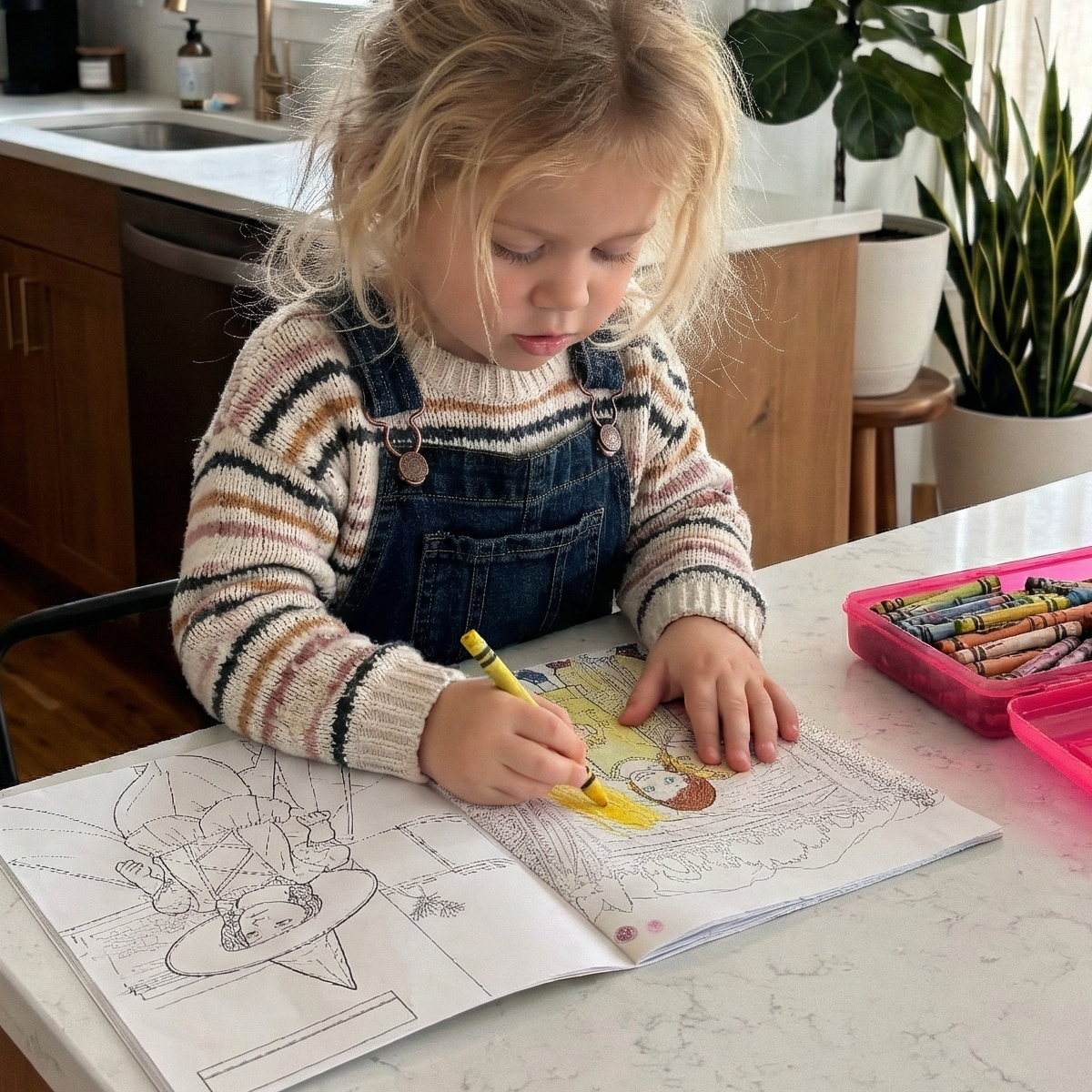
The sound of crayons on heavy paper, in a quiet kitchen, while dinner is on the stove.
That's the quiet you didn't know you needed.
Here's one thing worth knowing before you order: the book takes 5–7 business days to ship, so it's not a same-day solution. Plan ahead if it's for a birthday or holiday. Also, not every photo converts perfectly — close-up faces with clear expressions work best, and very dark or very blurry photos may need some adjustment before they're ready to use.
Here's an honest look at how it all comes together:
- Candid, real-life photos produce more joyful coloring pages than staged portraits
- Heavy artist-grade paper handles markers, crayons, and colored pencils without bleeding
- Lay-flat binding makes it genuinely easy for kids under six to color edge-to-edge
- Digital gift codes let extended family participate without ordering extra copies
- Meaningful for grandparents to give — sends presence across any distance
- Ships in 5–7 business days — not suitable as a last-minute or same-day gift
- Very dark, blurry, or heavily shadowed photos may not convert cleanly — close-up faces in good light work best
Common questions about custom photo coloring books
The most common questions are about photo quantity, paper type, old physical photos, and digital gifting options. Here are the direct answers.
These come up constantly, so let's move through them quickly.
How many photos do I need for a full coloring book? Most books work well with 10–20 photos. That's enough to tell a real story — a birthday, a season, a year — without padding. If you have fewer, some services let you use the same photo in different creative variations (like a full-page version and a detail close-up).
What paper weight is best for coloring with markers? Look for paper described as artist-grade or 80–100 lb weight. That's thick enough to handle washable markers without bleed-through. Anything lighter than 60 lb will buckle and bleed, which ruins the coloring experience and the page underneath.
Can I scan old physical photos to use? Absolutely. Scan them at 600 DPI for best results — most flatbed scanners and smartphone scanning apps handle this well. This opens up a whole category of meaningful gifts: your own childhood photos, old family holiday shots, decades-old pictures of grandparents as young parents.
Is there a way to share coloring pages digitally with family? Yes. Memory Doodle includes special digital gift codes with every order, so you can instantly share select pages with grandparents, cousins, or friends who want to color along. It's a nice way to extend the gift without ordering multiple physical copies.
One last tip that most guides skip: if your child is under four, expect them to scribble over the entire page rather than color inside the lines. That's completely normal — and actually fine, because good heavy paper handles it without tearing. Don't worry about "wasted" pages. The scribbling is still them interacting with a book about themselves, and that still matters.
Ready to turn your family photos into something they'll color for years?
Memory Doodle is a premium storytelling service that transforms your favorite family snapshots into beautiful, custom-bound coloring books....
- Instant Peace: Enjoy 30–60 minutes of quiet, screen-free focus while your child explores their creativity.
- The "Look, It’s Me!" Moment: Boost your child’s confidence by making them the hero of their very own book.
- Meaningful Gifting: Easily share the joy with your inner circle using our simple digital gift codes.
Frequently Asked Questions
How many photos do I need to make a custom coloring book?
What is the best paper weight for coloring with markers?
Can I turn old physical photos into a coloring book?
Is there a way to share custom coloring pages digitally with family?